
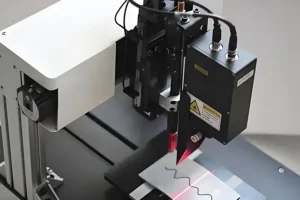

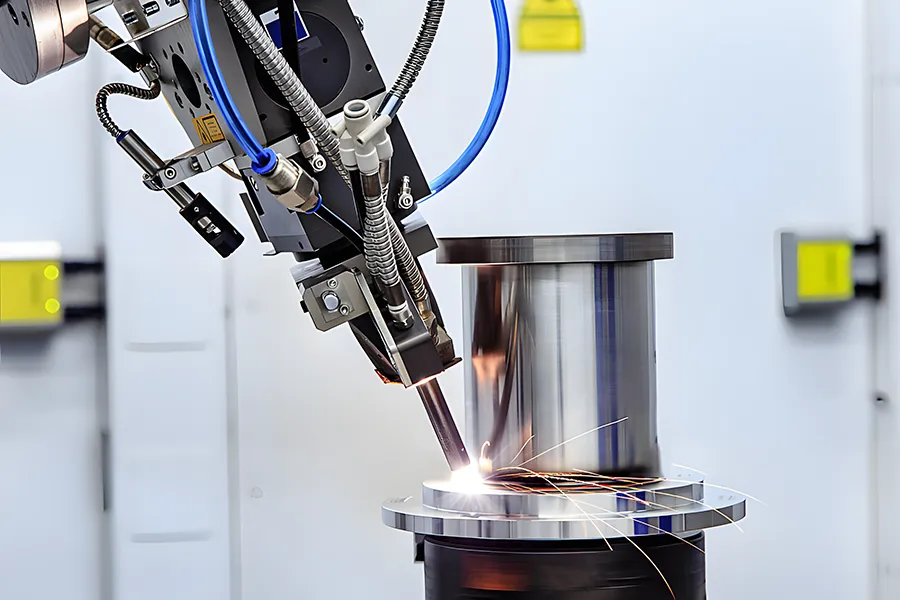
Amidst the surging tide of Industry 4.0, collaborative robots—or “cobots”—are reshaping the manufacturing landscape with a disruptive force, leveraging their unique advantages of safety, flexibility, and ease of use. Moving beyond the image of mechanical arms “caged” within traditional factories, they have transformed into intelligent partners capable of working side-by-side with humans.
1. Collaborative Robots: Definition and Characteristics
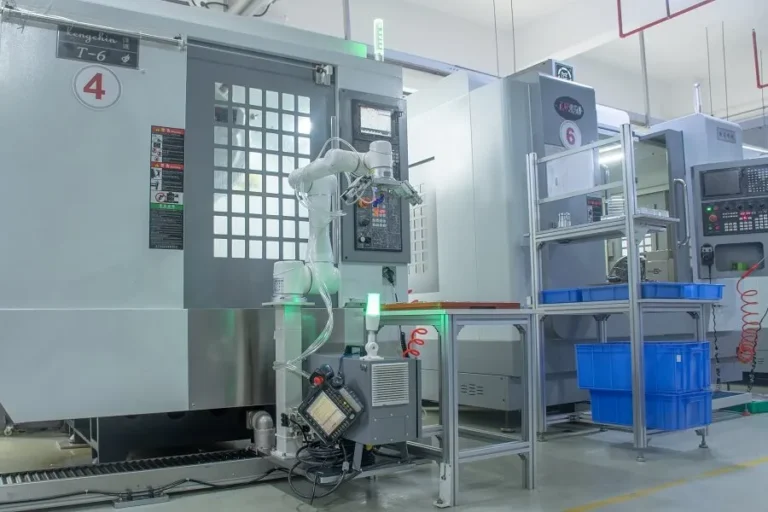
A collaborative robot is a type of robot meticulously designed to work directly alongside humans within a shared workspace. Its core objective is to significantly boost production efficiency and flexibility through safe and highly effective human-robot interaction. Akin to having “intelligent eyes” and “acute nerves,” these robots are equipped with advanced sensors, control systems, and software that enable them to precisely perceive their surroundings and engage in safe, friendly interactions with humans.
Their design places a primary focus on ensuring the absolute safety of human interaction; consequently, they can operate freely in open environments without the need for physical barriers or isolation measures.
Compared to traditional industrial robots, collaborative robots are typically lighter and more agile. Furthermore, they incorporate safety features—such as force-sensing sensors and emergency stop buttons—making them perfectly suited for a wide array of work scenarios that require human-robot collaboration.
2. Explosive Growth: A Global Overview of the Collaborative Robot Market
2.1 Market Data: Rapid Expansion
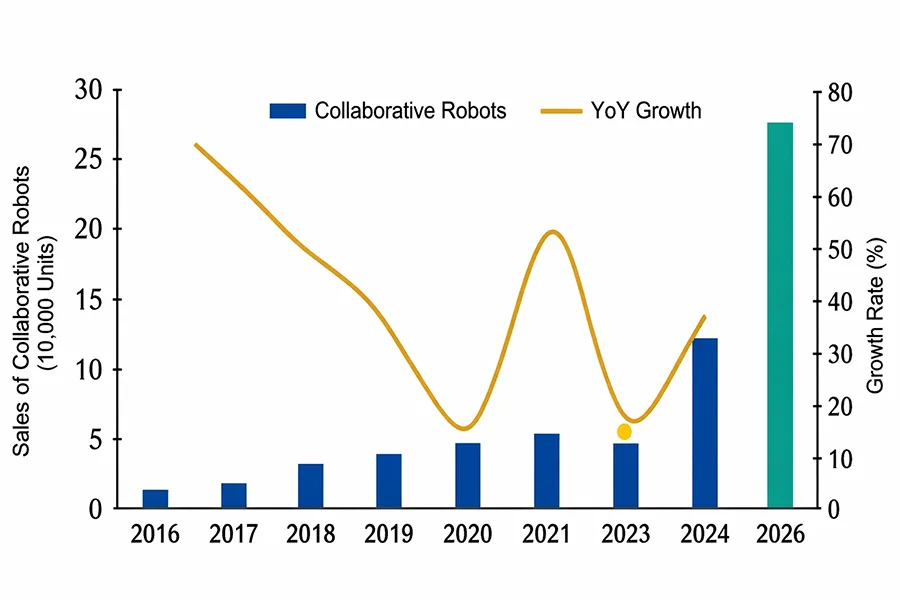
In 2022, the global collaborative robot market experienced explosive growth, with sales reaching 78,500 units and an average annual growth rate exceeding 38%. The Chinese market, in particular, demonstrated exceptional performance; having recorded a sales growth rate of 81.8% in 2021, it is projected to surpass the 100,000-unit mark by 2026, thereby showcasing immense market potential.
2.2 Driving Factors: A Multifaceted Approach
- Rising Labor Costs
As labor costs continue their upward trajectory, the corporate demand for production automation has become increasingly urgent, thereby creating vast opportunities for the expansion of the collaborative robot market.
- Technological Maturity
The safety and precision of collaborative robots have now reached industrial-grade standards (accurate to 0.02mm), enabling them to fully meet the requirements of high-precision manufacturing processes.
- Demand for Flexible Production
In today’s fiercely competitive market environment, small-batch, customized production is emerging as a dominant trend; the inherent flexibility of collaborative robots aligns perfectly with this evolving demand.
3. The Four Core Scenarios of Human-Robot Collaboration
3.1 Fixed Collaboration: A Precision Stage for Multi-Robot Cooperation
In the 3C electronics industry, multiple robots work in close coordination—guided by advanced vision systems—to achieve fully automated processes for tasks such as motherboard handling, assembly, and inspection. A prime example is the automotive parts tightening workstation, where the synchronization error between multiple robots during simultaneous operation is less than 0.1 mm—a level of precision that is truly astonishing.
3.2 Mobile Collaboration: The “All-Purpose Assistant” That Transcends Spatial Boundaries
Composite robots (combining a mobile platform with a robotic arm) have broken through spatial constraints, opening up a wealth of new possibilities for manufacturing and production. These mobile collaborative robots—or composite robots—consist of a collaborative robot mounted onto a movable platform. Standard configurations include manually operated carts and Automated Guided Vehicles (AGVs); however, as technology advances, more specialized multifunctional platforms—such as legged and tracked systems—have also emerged.
3.3 Medical Field
In the medical field, surgeons can manually guide robots during orthopedic procedures—specifically for joint cavity milling—leveraging extremely high force-control precision to effectively ensure patient safety. In the power sector, AGVs equipped with collaborative robots are used to manipulate high-voltage switches, successfully replacing hazardous manual labor.
3.4 Special Rescue Mission
Furthermore, quadruped robots are capable of navigating mountainous terrain for rescue operations, while tracked robots can venture deep into chemical plants to execute explosive ordnance disposal (EOD) missions—demonstrating the vast potential for mobile collaboration across a wide spectrum of applications.
4. Technical Challenges: How to Balance Safety and Performance?
4.1 Current Challenges: A Stark Contradiction
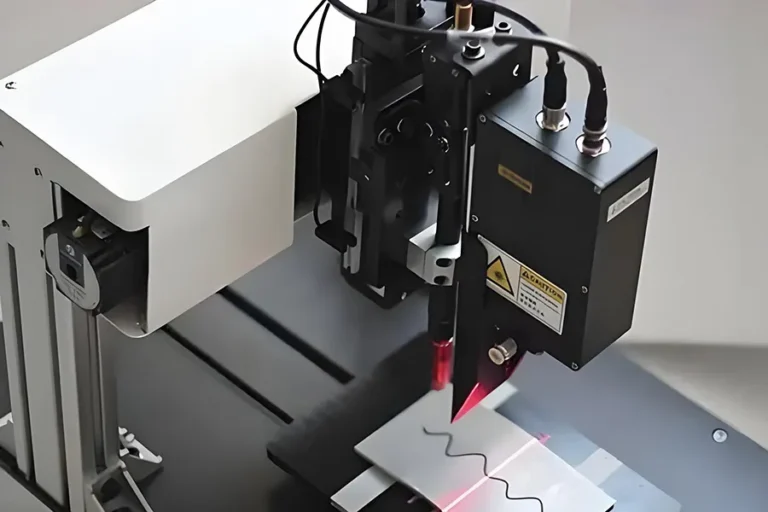
Currently, collaborative robots face two major inherent contradictions. The first is the trade-off between safety and speed: high-payload (300 N) and high-speed (3 m/s) models often must sacrifice speed to ensure human-robot safety. For instance, the ABB CRB1100 utilizes laser fencing technology to dynamically adjust its operational radius based on the surrounding environment. The second challenge lies in integration complexity: a single joint module must house over a dozen components—including motors, encoders, and torque sensors—which significantly increases design complexity. Consequently, the localization of key components and technologies has become the critical strategy for overcoming this bottleneck.
4.2 Directions for Technical Breakthroughs: Innovation as the Guiding Force
- Intelligent Perception
3D vision systems enable robots to perform unstructured picking tasks, while 6-axis force sensors allow massage robots to simulate the tactile sensation of human hands—thereby significantly enhancing the robots’ perceptual capabilities.
- AI Integration
Deep learning algorithms empower robots with the ability to autonomously adapt to their environments, propelling the industry toward a “zero-programming” era and further expanding the scope of robotic applications.
5. Future Outlook: AI + Robotics = Infinite Possibilities
5.1 Industry Chain Integration: A Closed Loop Emerges
The industry chain is undergoing rapid integration; a complete closed loop—spanning everything from core components to end-user applications—has taken shape, providing a solid foundation for the advancement of collaborative robots.
5.2 Future Trends: A Bright Horizon
- Explosion of Application Scenarios
The penetration rate of collaborative robots is set to rise steadily across sectors such as medical surgery, agricultural harvesting, and retail, thereby opening up vast new market opportunities.
- Technological Convergence
The combination of 5G and edge computing will enable millisecond-level response times, while the Internet of Things (IoT) will serve as the neural network for smart factories, propelling collaborative robots to new heights of sophistication.
Summary
Collaborative robots stand at the very forefront of the smart manufacturing revolution. With their unique appeal and immense potential, they are leading the manufacturing sector toward a future defined by greater intelligence, efficiency, and safety. Let us look forward together to the near future, when collaborative robots will help us create a world that is even better than the one we know today!