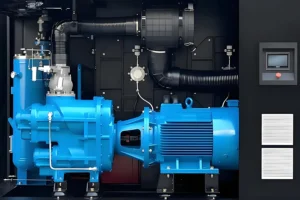

A coupling, also known as a shaft coupling, coupling wheel, or back wheel, is a key component that connects the pump shaft with the prime mover and transmits power. For pump applications, flexible couplings are generally preferred, and the metal coupling plays a vital role in such configurations. Its main purposes include:
- Compensating for the relative displacement between the pump shaft and the motor shaft
- Reducing the requirement for precise alignment during installation
- Mitigating impacts and altering the natural vibration frequency of the shafting
- Preventing harmful vibrations
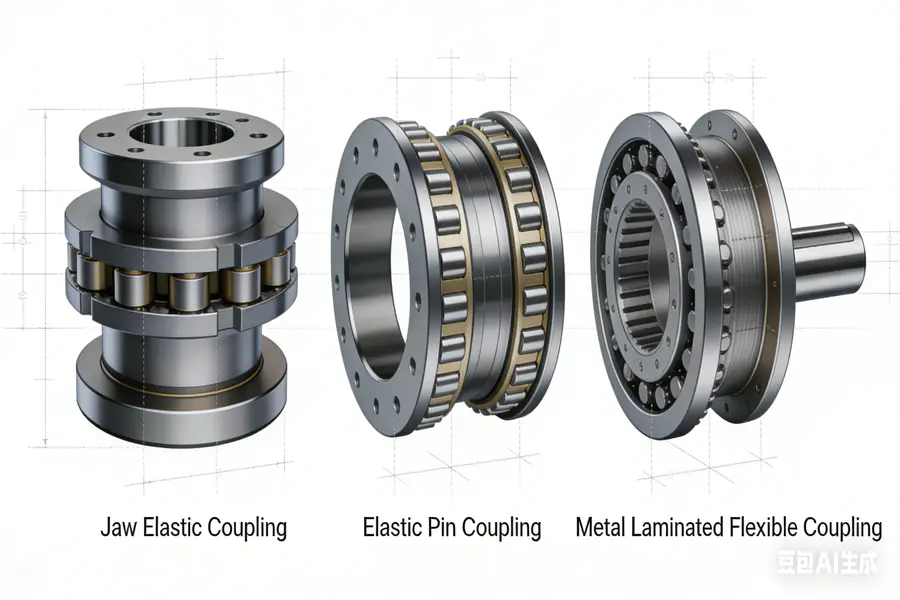
Three commonly used types of metal couplings are introduced in detail below:
Detailed Introduction to Each Metal Coupling Type
1. Jaw Elastic Coupling (Elastic Block Coupling)
The jaw elastic coupling (also called elastic block coupling) consists of three core components: pump-side coupling, motor-side coupling, and elastic block.
Key Features: Small size, light weight, simple structure, easy installation, and low cost.Application Scope: As a cost-effective metal coupling accessory, it is widely used in low-power, non-critical applications where high performance requirements are not required.
2. Elastic Pin Coupling
The elastic pin coupling connects the flanges of two half-couplings via pins. One end of the pin forms a fixed fit with the tapered pin hole on the half-coupling flange through a conical surface and nut; the other end is equipped with a rubber elastic sleeve, which is installed in the pin hole of the other half-coupling flange.
- Structural Variants:
- Standard type
- Extended type (adds an extension section, plus additional bolts, nuts, and washers to meet specific installation needs)
- Compliance Standard: GB/T 5014-2003 《Elastic Pin Couplings》
- Key Features: Simple structure, no lubrication required, easy installation and replacement, and low alignment accuracy requirements.
- Application Scope: Ideal for small-power pump units as a maintenance-friendly metal coupling alternative.
3. Metal Laminated Flexible Coupling (Metal Diaphragm Coupling)
Domestically produced metal laminated flexible couplings (also called metal diaphragm couplings) comply with JB/T 9147-1999 and are classified as “disc couplings” per API 671. The structure includes half-couplings, bushings, diaphragms (a set of ultra-thin metal spring sheets of various shapes), washers, and an intermediate shaft—with diaphragms bolted to the two half-couplings on the driving and driven shafts respectively.
Key Advantages:
- Simple structure & no lubrication required
- High-temperature resistance & easy installation/replacement
- High reliability & large torque transmission capacity
Application Scope: Suitable for demanding mechanical transmission scenarios, leveraging its high-temperature and high-torque capabilities.
Summary
Metal couplings are indispensable in mechanical transmission systems, ensuring efficient power transfer between shafts. The three common types each have distinct characteristics and application scopes:
| Coupling Type | Core Advantages | Application Scenarios |
|---|---|---|
| Jaw Elastic Coupling | Low cost, small size, easy installation | Low-power, non-critical applications |
| Elastic Pin Coupling | Maintenance-friendly, low alignment requirements | Small-power pump units |
| Metal Laminated Flexible Coupling | High reliability, high-temperature resistance, large torque | Harsh environments & high-torque transmission |
Choosing the right metal coupling based on specific working conditions and performance requirements is critical to ensuring the stable and efficient operation of mechanical equipment.