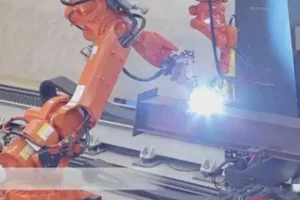
Robotic welding machines are increasingly widely used in modern industrial production, with industrial robots and collaborative robots being two mainstream types. Many enterprises and purchasers often feel confused when selecting: which robotic welding machine is more suitable for their own needs? In fact, the key to selection lies in matching the actual working scenarios and production requirements. Below is a detailed analysis from core dimensions to help you accurately choose the right equipment.
As an important type of robotic welding machine, industrial robots operate at high speed and have strong load-bearing capacity during welding. However, the high-speed movement may pose a risk of collision injuries, so they need to be isolated from operators through safety barriers, light curtains and other equipment. This type of robotic welding machine is more suitable for building independent welding workstations, occupying a relatively large overall space, and is ideal for workshops with loose layouts.
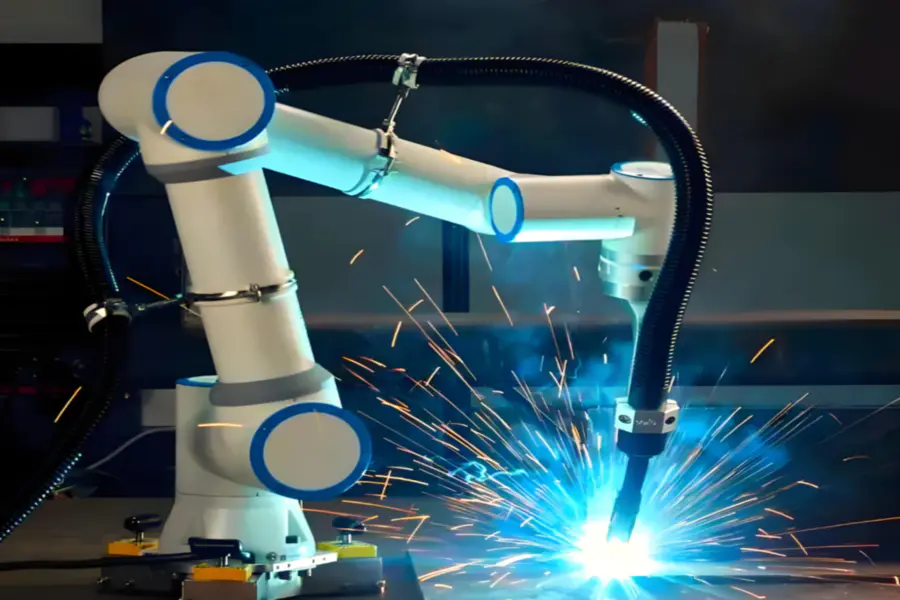
Collaborative robots are a type of robotic welding machine with outstanding flexibility. They are usually equipped with force control and visual sensing technologies, and will stop immediately upon contact with the human body or obstacles. They have the ability to work collaboratively with humans at the same workstation—for example, when workers assist in clamping workpieces, the equipment can carry out welding operations simultaneously. With higher space utilization, it is an ideal choice of robotic welding machine for compact workshops or scenarios with limited space.
This type of robotic welding machine has high repetitive positioning accuracy. The repetitive positioning accuracy of mainstream products on the market is generally ±0.02-0.05mm, which can stably complete complex welding seam operations such as curved surface welding. At the same time, it has a large arm span, adapting to the production needs of large batches and uniform welding standards such as automobile chassis and construction machinery. It is an efficient type of robotic welding machine in mass production scenarios.
The precision of this type of robotic welding machine is slightly lower. Currently, the precision of products on the market is mostly ±0.05-0.1mm, with a relatively gentle movement speed and a slightly smaller arm span. It is more suitable for small-part welding operations, such as the welding of hardware accessories and small structural parts, and is one of the preferred small-part robotic welding machines.
Industrial robotic welding machines require preset welding paths through programming. When production needs change and workpieces need to be replaced, the adjustment cycle is long, and they have certain requirements for the programming skills of operators. In addition, the initial investment cost of this type of robotic welding machine is relatively high, making it more suitable for long-term stable standardized production scenarios.
Collaborative robotic welding machines support drag-and-drop teaching functions. Operators can quickly get started without complex programming training, and the model change time is short when replacing production models, with a higher degree of flexibility. At the same time, their initial investment cost is relatively low, making them more suitable for the production needs of multiple varieties and small batches, and a cost-effective choice of robotic welding machine in flexible production scenarios.
In short, there is no need to blindly pursue high-end configurations when selecting a robotic welding machine. The key is to closely focus on the production capacity, precision and flexibility needs of your own welding scenarios: if you pursue high-precision and high-capacity standardized production and have an independent working space, industrial robots are a more suitable choice; if you need flexible production, human-machine collaborative operations or face space constraints, collaborative robots have more advantages.
By making a comprehensive judgment from dimensions such as working environment and production mode, you can select the robotic welding machine that truly meets your needs, providing strong support for the improvement of production efficiency and product quality assurance. If you need to further refine the selection plan, targeted analysis can be conducted in combination with specific working scenarios.


-300x153.webp "Ball Screw Precision Grades Explained: A Complete Guide for Selection")