Welding is a core process in container manufacturing. A standard 20-foot container involves hundreds of meters of weld seams, and welding quality directly determines the container’s structural strength, sealing integrity, and service life. However, container welding has long been plagued by issues such as the tendency of thin sheets to deform, the difficulty of keeping the torch aligned with long weld seams, and high rework rates. This situation is now being effectively transformed through the deep integration of intelligent weld seam tracking systems with welding robots.
1. Process Challenges in Container Welding
Containers are primarily manufactured using thin weathering steel sheets, typically 1.6–2.5 mm thick. The welding process faces the following challenges:
- Difficulty in Controlling Deformation in Thin Sheets
The material is sensitive to heat input; even slight errors can cause buckling or twisting, compromising the container’s appearance and dimensional accuracy.
- Tendency for Long, Straight Welds to Drift
Container side panels, roof panels, and underframes feature extensive long, straight welds. Thermal expansion during welding, combined with incoming material tolerances and fixture positioning errors, makes it difficult for traditional “teach-and-playback” robots to maintain precise alignment between the welding torch and the center of the seam.
- Strict Sealing Requirements
Containers used for maritime and land transport must meet rigorous waterproofing and moisture-proofing standards. Defects such as porosity, lack of fusion, or undercut directly compromise the container’s seal, potentially leading to cargo damage.
- High Rework Costs
Welding defects require remedial welding or even disassembly and rework on the production line, severely disrupting production cycles and increasing labor and material costs.
2. UMW Intelligent Weld Seam Tracking: Equipping Robots with “Smart Eyes”
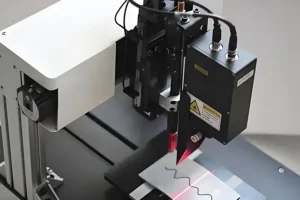
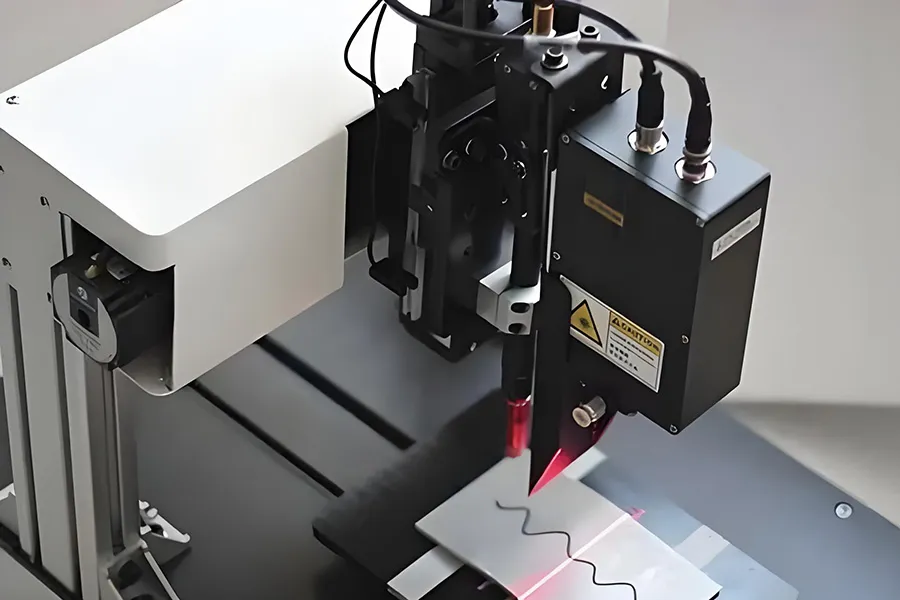
The UMW intelligent weld seam tracking system utilizes laser sensors to capture weld seam profile data in real time. Intelligent algorithms calculate deviations and adjust the welding robot’s motion trajectory instantaneously. Even in the presence of assembly errors or thermal deformation, the robot automatically adjusts the torch position, ensuring the weld bead remains precisely aligned with the center of the seam. In container welding, this system offers the following key advantages:
2.1 Real-time Correction Ensuring Consistency in Long, Straight Welds
Laser sensors scan the weld seam at millisecond intervals, achieving sub-millimeter detection accuracy. The system automatically compensates for issues such as slight waviness or fluctuations in joint gaps on container side panels, ensuring consistent weld quality and significantly reducing defect rates like weld misalignment and undercut.
2.2 Effective Control of Welding Deformation in Thin Sheets
Through precise seam tracking, the robot welds along the optimal path, avoiding localized overheating or repeated welding caused by trajectory deviations; this effectively controls deformation in thin-sheet welding and improves the overall flatness of the container body.
2.3 Enhanced Sealing Performance and Reduced Rework Rates
Stable weld bead formation directly results in excellent sealing performance. In practical applications, the adoption of UMW’s intelligent seam tracking system has raised the first-pass yield for container welding from 90% to over 97%, reduced rework rates by more than 70%, and drastically cut down on subsequent touch-up welding and grinding processes.
2.4 Increased Production Efficiency
Increased production efficiency is another significant benefit. The seam tracking system reduces the need for manual intervention and downtime for adjustments; combined with the robot’s capability for continuous operation, the welding time per container can be shortened by 15%–20%.
3. Flexible Robot Compatibility and Suitability for Various Weld Types
The UMW intelligent seam tracking system is compatible with mainstream domestic and international welding robots and offers easy installation and commissioning. In container welding scenarios, the system reliably handles various weld types—including long straight welds, fillet welds, and lap welds—meeting the diverse requirements of thin-sheet container welding.
Conclusion
Container manufacturing is rapidly transforming toward automation and intelligence. Leveraging core technologies such as high-precision laser sensing, real-time deviation correction, and deep robot integration, UMW’s intelligent seam tracking system effectively addresses industry pain points—including thin-sheet deformation, misalignment on long straight welds, poor sealing, and high rework rates—providing a mature and reliable solution for container welding.
Looking ahead, as smart factories demand ever-higher standards for welding quality and efficiency, UMW will continue to empower container manufacturers to fully upgrade their automated welding processes, driving weld quality consistency to new heights.