
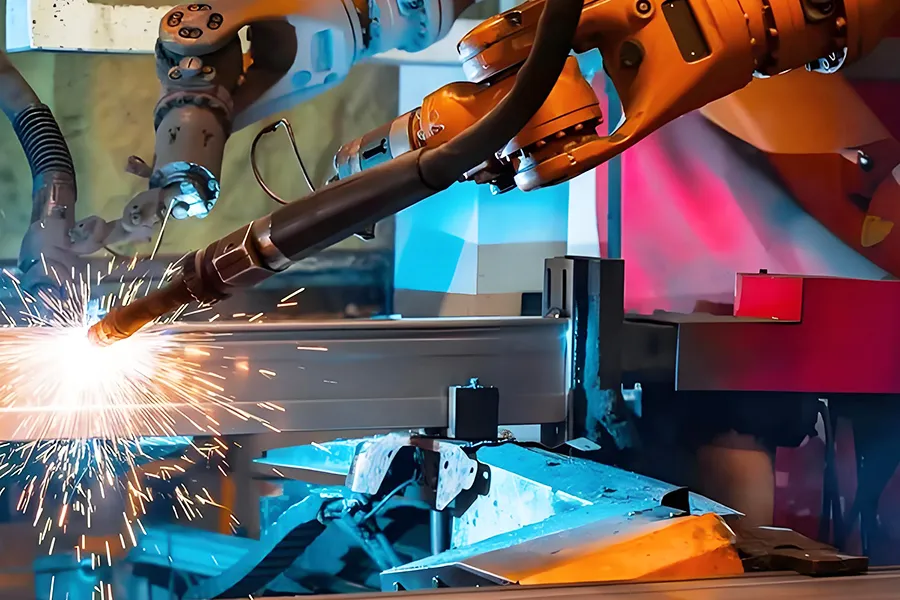
With the rapid development of manufacturing towards intelligence and digitalization, welding, as a key process in metal processing, directly impacts product quality and production efficiency due to its automation level. Arc welding robots, with their advantages of high precision, high stability, and strong repeatability, have become indispensable equipment in the field of industrial automation.
1. Basic Concepts of Arc Welding Robots
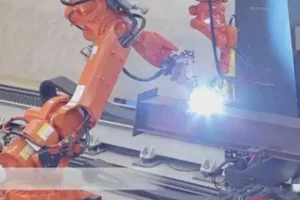
An arc welding robot is an automated device integrating industrial robot technology and arc welding technology. It is mainly used to achieve automated welding using MIG, MAG, TIG, and other arc welding methods. Its core components include the industrial robot body, welding power source, wire feeding system, welding torch, control system, and related safety protection devices.
On industrial automated production lines, arc welding robots, through pre-programming, complete weld seams according to set trajectories and welding parameters, enabling long-term stable operation and ensuring consistent welding quality.
2. Welding Challenges in the Context of Industrial Automation
In traditional manual welding, manufacturing enterprises generally face the following problems:
2.1 Unstable Welding Quality
Welding quality is greatly affected by welder experience, operating conditions, and environmental factors, making standardization and consistency difficult to achieve.
2.2 Limited Production Efficiency
Manual welding is slow, making it difficult to meet the requirements of batch and rhythmic production, thus hindering overall capacity improvement.
2.3 High Labor Costs and Safety Pressures
Welding is a high-intensity, high-risk job. There is a shortage of welders, high training costs, and safety hazards such as fumes, high temperatures, and electric arcs.
2.4 Low Automation and Digitalization Levels
Manual welding makes data collection and process traceability difficult, hindering lean production and quality management.
These problems have prompted more and more companies to introduce arc welding robots to accelerate the automation upgrade of welding processes.
3. Advantages of Arc Welding Robots in Industrial Automation
3.1 Stable and Consistent Welding Quality
Arc welding robots can precisely control welding current, voltage, welding speed, and welding torch posture, resulting in stable weld formation and uniform penetration, significantly reducing defects such as incomplete welds and missed welds.
3.2 Significantly Improved Production Efficiency
Robots can operate continuously for 24 hours with stable welding speed. Combined with positioners and automatic fixtures, the welding time for a single product can be significantly shortened, improving overall production line efficiency.
3.3 Reduced Labor Costs and Safety Risks
Robots replace manual labor in high-intensity, repetitive welding tasks, reducing reliance on skilled welders and effectively lowering the risk of occupational injuries and safety accidents.
3.4 Easy Standardization and Scalable Production
Through program replication and parameter calling, arc welding robots are well-suited for welding standard parts and batch products, facilitating scalable production and quality control.
3.5 Support for Digitalization and Intelligent Manufacturing
Arc welding robots can interface with MES, ERP, and other systems to achieve welding data acquisition, process traceability, and production analysis, providing a data foundation for intelligent manufacturing.
4. Typical Configuration of an Arc Welding Robot System
A complete industrial automated arc welding robot system typically includes the following components:
- Industrial Robot Body:** A multi-jointed six-axis robot with excellent flexibility and welding accessibility, adaptable to complex weld seams.
- Welding Power Supply and Wire Feeding System:** Supports multiple welding processes such as MIG, MAG, and TIG, with stable and controllable welding parameters.
- Welding Torch and Cleaning Device:** Ensures continuous welding process and reduces downtime for maintenance.
Positioners and tooling fixtures enable workpiece flipping and precise positioning, improving welding quality and efficiency.
Safety protection systems include safety fences, light curtains, and emergency stop devices to ensure personnel and equipment safety.
5. Key Considerations for Selecting Welding Power Sources and Welding Torches Suitable for Robots
5.1 Welding Power Sources Suitable for Robots
Welding power sources for welding robots must possess the following characteristics:
- The power output must meet the high output and high stability requirements of automated robotic welding.
- The duty cycle of the welding power source is a crucial parameter for measuring its power output. It is typically calibrated for continuous working time using a 10-minute measurement cycle.
- The basic calculation principle is that the duty cycle of power output is inversely proportional to the square of the welding current. The maximum current I100% during continuous welding can be calculated using the following formula.
5.2 Welding Torches Suitable for Robots
- Robot welding torches must meet the high load-bearing capacity requirements of automated robotic welding. Similar to welding power sources, welding torches also have a duty cycle to measure their working capacity. When selecting the welding current, the load capacity of the welding torch must be considered in conjunction with the specific conditions of continuous operation.
- Because robotic welding typically operates at high speeds, the quality of the welding torch directly determines the stability of the electric arc, thus impacting weld quality.
- Robotic welding requires the welding torch’s TCP point (the tip of the welding wire) to have good stability to ensure accurate arc positioning during welding.
- The TCP point accuracy of welding torches of the same model must be sufficiently guaranteed. This ensures that the TCP point of the previous torch matches the TCP point of the new torch when changing torches, minimizing system downtime and improving work efficiency.
Summary
Arc welding robots used in industrial automation are not only important tools for upgrading welding processes but also key equipment for manufacturing enterprises to achieve intelligent manufacturing and high-quality development.