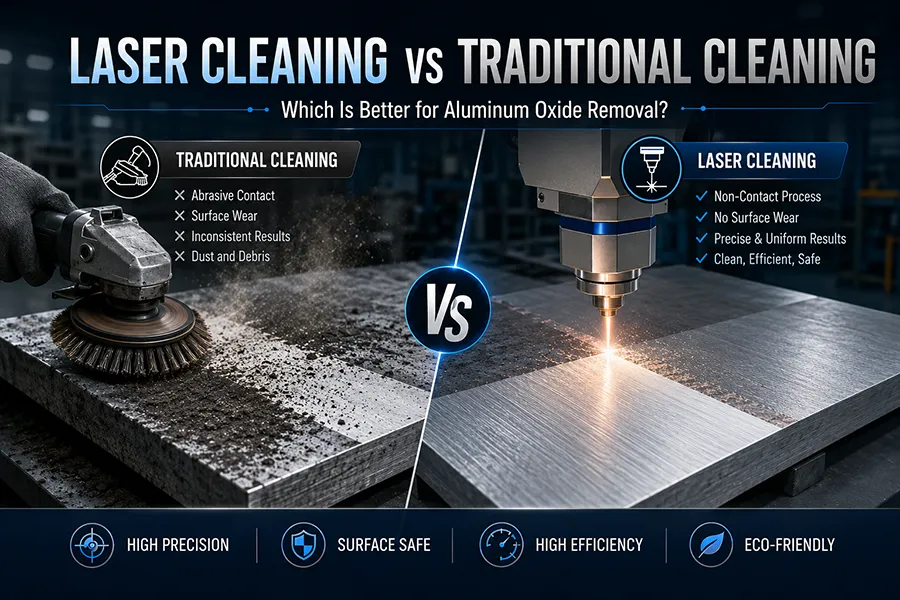
Aluminum is widely used in welding, automotive manufacturing, aerospace, shipbuilding, machinery, and metal fabrication. However, aluminum surfaces naturally form an oxide layer when exposed to air. Before welding, coating, bonding, or surface treatment, this aluminum oxide layer often needs to be removed properly.
There are several common ways to remove aluminum oxide, including mechanical cleaning, chemical cleaning, and laser cleaning. Each method has its own advantages and limitations. In industrial production, the best cleaning method depends on the material condition, production efficiency, surface quality requirements, environmental standards, and long-term operating cost.
Among these options, laser cleaning has become an increasingly popular solution because it offers precise, non-contact, and highly controllable cleaning performance. This article compares laser cleaning and traditional cleaning methods to help you understand which method is more suitable for aluminum oxide removal.
What Is Traditional Cleaning?
Traditional cleaning usually refers to mechanical cleaning and chemical cleaning.
Mechanical cleaning removes oxide layers through physical contact. Common methods include grinding, sanding, brushing, scraping, polishing, and abrasive blasting. These methods are simple and widely used, but they usually depend heavily on manual operation and operator experience.
Chemical cleaning uses acids, alkaline solutions, or other chemical agents to dissolve or remove oxide layers from the metal surface. It can be effective for some applications, especially when treating complex shapes or batch parts. However, it may involve chemical residues, wastewater treatment, corrosion risks, and safety concerns.
Traditional cleaning methods are still used in many factories because the initial investment is relatively low. However, for high-quality welding, automated production, or precision surface treatment, their limitations become more obvious.
What Is Laser Cleaning?
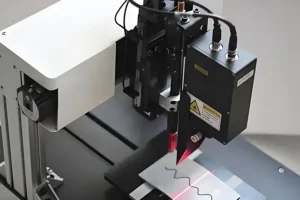
Laser cleaning is a non-contact surface cleaning technology. It uses a high-energy laser beam to remove rust, oxide layers, paint, oil, coatings, or contaminants from the surface of a material.
When the laser beam reaches the aluminum oxide layer, the surface contamination absorbs laser energy and is rapidly heated, vaporized, peeled off, or separated from the substrate. Since the laser parameters can be precisely controlled, the oxide layer can be removed while minimizing damage to the aluminum base material.
Laser cleaning can be used manually or integrated into automated production lines. It is especially suitable for applications that require high cleanliness, stable surface quality, low substrate damage, and repeatable processing results.
Laser Cleaning vs Traditional Cleaning: Key Differences
1. Surface Consistency
One of the most important differences between laser cleaning and traditional cleaning is surface consistency.
Mechanical cleaning often depends on the skill, pressure, angle, and experience of the operator. As a result, the oxide layer may be removed unevenly. Some areas may be over-cleaned, while other areas may still have oxide residue. This inconsistency can affect welding quality, coating adhesion, or bonding strength.
Chemical cleaning can provide relatively uniform treatment, but it may also cause uneven reaction if the chemical concentration, immersion time, temperature, or surface condition is not well controlled.
Laser cleaning offers better repeatability and consistency. The laser beam can be precisely controlled by power, scanning speed, pulse width, frequency, and cleaning path. This makes it easier to achieve a uniform cleaning effect across the surface.
For aluminum oxide removal before welding, consistent surface preparation is especially important because it directly affects weld stability, weld strength, and final product quality.
2. Material Damage
Traditional mechanical cleaning methods may damage the aluminum substrate. Grinding, sanding, or brushing can scratch the surface, remove base material, or change the original surface roughness. For precision parts, thin aluminum sheets, or high-value components, this can be a serious problem.
Chemical cleaning may also damage the base material if the chemical reaction is too strong or not properly controlled. Over-cleaning, corrosion, and chemical residues can affect the structural integrity and surface performance of the aluminum.
Laser cleaning is a non-contact process. It does not rely on physical friction, so it can reduce the risk of scratching or removing the aluminum base material. With proper parameter settings, laser cleaning can remove the oxide layer while preserving the original surface condition of the aluminum.
This makes laser cleaning especially suitable for applications where surface finish, dimensional accuracy, and material integrity are important.
3. Cleaning Speed and Efficiency
Mechanical cleaning usually requires manual labor and repeated physical operation. For small areas, it may be acceptable. But for large workpieces or batch production, the process becomes slow and labor-intensive.
Chemical cleaning can treat multiple parts at once, but it requires preparation, immersion, reaction time, rinsing, drying, and waste treatment. The entire process can be complicated and time-consuming.
Laser cleaning is fast and efficient. The laser beam can instantly remove oxide layers from the surface. It can be used for spot cleaning, line cleaning, selective cleaning, or continuous cleaning. For industrial production, laser cleaning can greatly improve processing efficiency, especially when integrated with robots, CNC systems, or automated welding lines.
For companies that need stable production speed and reduced manual labor, laser cleaning provides a clear advantage.
4. Automation Capability
Mechanical cleaning is difficult to automate because it often requires manual judgment, pressure control, and tool adjustment. Even when robotic grinding or brushing is used, tool wear and surface consistency remain challenges.
Chemical cleaning can be integrated into automated production lines, but it requires tanks, pumps, chemical control systems, rinsing systems, drying systems, and wastewater treatment equipment.
Laser cleaning is easier to integrate into automated systems. It can be combined with robotic arms, gantry systems, welding production lines, or customized fixtures. The cleaning path can be programmed, and the process can be repeated with high accuracy.
For modern factories pursuing automated welding, smart manufacturing, and reduced labor dependence, laser cleaning is a more flexible solution.
5. Environmental Impact
Environmental protection is another major difference between laser cleaning and traditional cleaning.
Mechanical cleaning may produce dust, abrasive waste, noise, and secondary pollution. Abrasive blasting can generate large amounts of waste media and contaminated dust.
Chemical cleaning has a greater environmental burden. It may generate hazardous wastewater, chemical residues, acid mist, and toxic waste. These materials must be properly handled, stored, treated, and disposed of according to environmental regulations.
Laser cleaning is cleaner and more environmentally friendly. It does not require chemical agents or abrasive materials. The removed oxide and contaminants are mainly converted into smoke, dust, or fine particles, which can be collected by a fume extraction and filtration system.
Therefore, laser cleaning helps reduce chemical use, waste disposal pressure, and environmental compliance costs.
6. Precision
Laser cleaning provides excellent precision. The laser spot size, scanning path, energy density, and cleaning range can be accurately controlled. It can clean selected areas without affecting surrounding surfaces.
Mechanical cleaning has lower precision because it depends on physical tools and manual operation. It is difficult to control the exact depth and area of material removal.
Chemical cleaning can reach complex surfaces and hidden areas, but the chemical reaction is less selective. It may affect areas that do not need to be cleaned and may damage the base material if not controlled carefully.
For precision aluminum parts, weld seams, battery components, aerospace parts, molds, and high-value industrial components, laser cleaning is often a better choice.
7. Maintenance Requirements
Traditional mechanical cleaning tools wear out quickly. Brushes, grinding wheels, sandpaper, abrasive media, and polishing tools need frequent replacement. This increases consumable cost and downtime.
Chemical cleaning requires regular replacement of chemical solutions, tank cleaning, wastewater treatment, and safety management. The maintenance workload can be high.
Laser cleaning systems have fewer consumables. The main maintenance items usually include optical components, protective lenses, cooling systems, and fume extraction units. Compared with mechanical and chemical cleaning, laser cleaning generally requires less routine maintenance and offers more stable long-term operation.
8. Cost Comparison
The initial investment of laser cleaning equipment is usually higher than traditional cleaning tools. This is one reason why some factories still choose mechanical or chemical cleaning.
However, the total cost should not be evaluated only by purchase price. Long-term cost includes labor, consumables, maintenance, waste treatment, rework, production efficiency, and quality control.
Mechanical cleaning has a low initial cost but high labor and consumable costs. Chemical cleaning also has relatively low equipment cost, but chemical purchase, safety management, wastewater treatment, and environmental compliance can increase long-term expenses.
Laser cleaning has a higher upfront cost, but it can reduce labor dependence, lower consumable usage, reduce waste treatment, improve cleaning consistency, and support automated production. In many industrial projects, laser cleaning provides a better total cost of ownership over time.
Conclusion
Laser cleaning and traditional cleaning are both widely used in industrial surface treatment, but they are suitable for different production needs.
Traditional mechanical cleaning has a low initial cost, but it may cause scratches, uneven cleaning, high labor demand, and frequent tool replacement. Chemical cleaning can be effective, but it may create corrosion risks, chemical waste, and environmental treatment costs.