
Laser welding represents one of the most significant applications of laser processing technology and stands as the most highly anticipated and promising welding technique of the 21st century. Compared to traditional welding methods, laser welding offers numerous advantages, including superior weld quality and faster processing speeds. Currently, laser welding technology is widely utilized across diverse fields, such as manufacturing, powder metallurgy, the automotive industry, the electronics sector, and biomedicine.
1. Principles of Laser Welding
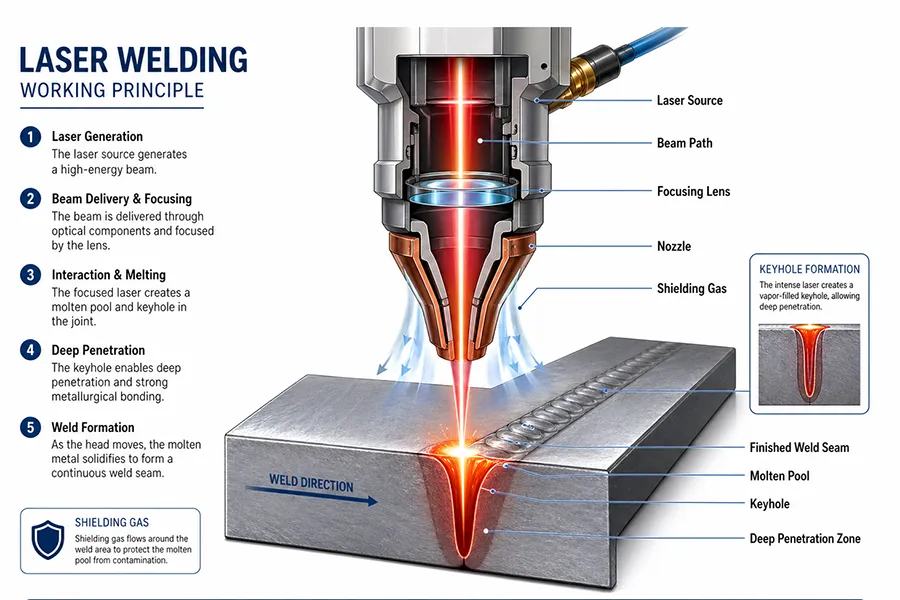
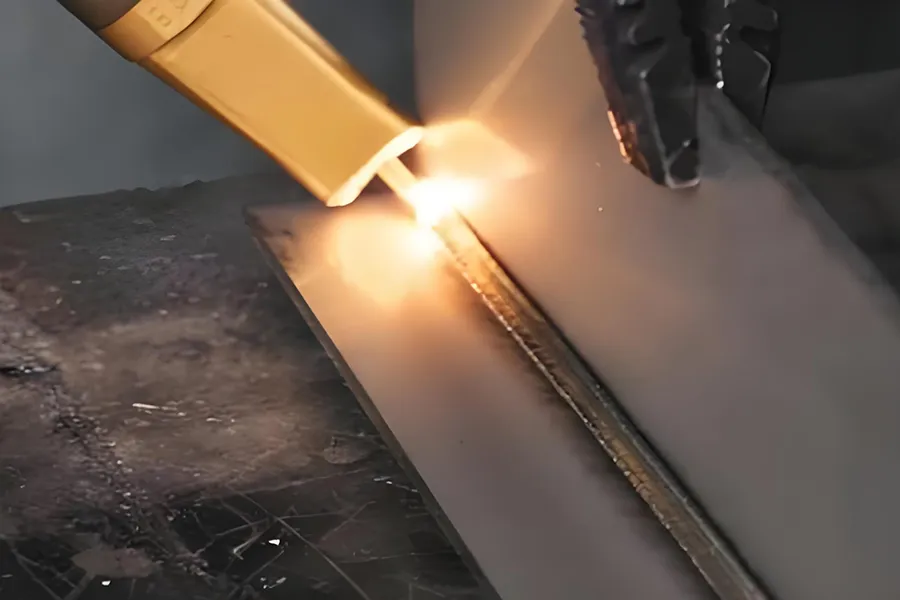
Laser welding is classified as a fusion welding process that employs a laser beam as its heat source. Its underlying principle involves exciting an active medium—via specific methods—to oscillate back and forth within an optical resonator cavity, thereby generating a beam of stimulated emission light. When this beam interacts with a workpiece, its energy is absorbed by the material; once the temperature of the material reaches its melting point, welding can commence.
2. How Laser Welding Works?
Based on the mechanism by which the weld pool is formed, laser welding can be categorized into two fundamental mechanisms: conduction welding and deep penetration (keyhole) welding. In conduction welding, the generated heat diffuses into the interior of the workpiece via thermal conduction, causing the surface of the weld seam to melt; this process typically involves negligible vaporization. It is frequently employed for the low-speed welding of thin-walled components. Deep penetration welding, conversely, causes the material to vaporize, generating a substantial volume of plasma; due to the intense heat involved, a “keyhole” phenomenon appears at the leading edge of the weld pool. Deep penetration welding enables full-thickness penetration of the workpiece and is characterized by high energy input and rapid welding speeds, making it currently the most widely adopted mode of laser welding.
3. Key Process Parameters in Laser Welding
Numerous process parameters influence the quality of laser welding, including power density, laser pulse waveform, defocusing distance, welding speed, and the use of auxiliary shielding gas.
3.1 Laser Power Density
Power density is one of the most critical parameters in laser processing. When a high power density is applied, the surface layer of the material can be heated to its boiling point within a timeframe of mere microseconds, resulting in significant vaporization. Consequently, high power density is highly advantageous for material removal processes, such as drilling, cutting, and engraving. Conversely, with a lower power density, it takes several milliseconds for the surface layer to reach its boiling point; during this interval—and prior to surface vaporization—the underlying layers reach their melting point, thereby facilitating the formation of a robust fusion weld. As such, in conduction-mode laser welding, the optimal power density typically falls within the range of 10⁴ to 10⁶ W/cm².
3.2 Laser Pulse Waveform
The laser pulse waveform is a critical parameter that not only distinguishes between material removal and material melting but also determines the physical size and cost of the processing equipment. When a high-intensity laser beam strikes a material surface, 60% to 90% of the laser energy is reflected and lost—a phenomenon particularly pronounced in materials such as gold, silver, copper, aluminum, and titanium, which exhibit high reflectivity and rapid heat conduction. During the duration of a single laser pulse, the reflectivity of the metal surface varies over time. As the surface temperature rises to the material’s melting point, reflectivity drops rapidly; once the surface enters a molten state, its reflectivity stabilizes at a specific value.
3.3 Laser Pulse Duration (Pulse Width)
Pulse duration is a vital parameter in pulsed laser welding. The optimal pulse duration is determined by the required weld penetration depth and the extent of the heat-affected zone (HAZ). Generally, a longer pulse duration results in a larger HAZ, while the weld penetration depth increases in proportion to the square root (1/2 power) of the pulse duration. However, increasing the pulse duration simultaneously reduces the peak power output. Consequently, longer pulse durations are typically employed in heat-conduction welding modes, producing weld seams that are broad yet shallow—a configuration particularly well-suited for the lap welding of both thin and thick plates. Nevertheless, excessively low peak power can lead to superfluous heat input; for any given material, there exists a specific, optimal pulse duration that maximizes the achievable weld penetration depth.
3.4 Defocusing Distance
Laser welding typically necessitates a certain degree of defocusing. This is because the power density at the center of the laser spot—located precisely at the focal plane—is often excessively high, creating a risk of material vaporization and the formation of keyholes (perforations). In planes situated either above or below the focal plane, the distribution of power density is relatively more uniform.
There are two primary modes of defocusing: Positive defocusing and negative defocusing. Positive defocusing occurs when the focal plane is positioned *above* the workpiece surface, whereas negative defocusing occurs when it is positioned *below* the workpiece surface. According to the principles of geometric optics, if the distance between the focal plane and the welding plane is equal for both positive and negative defocusing modes, the power density distribution across the corresponding planes should be approximately identical. In practice, however, the resulting weld pool geometries often exhibit distinct differences. Specifically, negative defocusing tends to yield greater weld penetration depths—a phenomenon attributed to the specific dynamics involved in the formation of the weld pool.
3.5 Welding Speed
Welding speed is a critical factor that determines the quality of the weld surface, the weld penetration depth, and the extent of the heat-affected zone (HAZ). The rate of welding speed directly influences the amount of heat input delivered to the workpiece per unit of time. If the welding speed is too slow, the heat input becomes excessive, potentially leading to “burn-through”—where the workpiece is completely perforated. Conversely, if the welding speed is too fast, the heat input becomes insufficient, resulting in incomplete penetration—where the weld fails to extend through the full thickness of the workpiece. Typically, the welding speed is reduced to improve penetration depth.
3.6 Auxiliary Shielding Gas Blowing
The auxiliary blowing of shielding gas is an indispensable process in high-power laser welding. On one hand, it serves to prevent spatter from the molten metal from contaminating the focusing lens; on the other, it prevents the excessive accumulation of plasma generated during the welding process, which would otherwise block the laser beam from reaching the material surface. During laser welding, gases such as helium, argon, and nitrogen are commonly used to shield the weld pool, thereby protecting the workpiece from oxidation during the welding operation. Factors such as the type of shielding gas, gas flow rate, and blowing angle have a significant impact on the welding results; furthermore, different blowing methods can also influence the overall welding quality.
Helium is difficult to ionize (possessing a high ionization energy), allowing the laser beam to pass through unimpeded so that the beam energy reaches the workpiece surface without obstruction. This makes it the most effective shielding gas for laser welding, though it is relatively expensive.
Argon is less expensive and possesses a higher density, resulting in effective shielding performance. However, it is susceptible to ionization by high-temperature metal plasma; consequently, it partially shields the beam directed at the workpiece, thereby reducing the effective laser power available for welding and compromising both welding speed and penetration depth. Nevertheless, the surface finish of a weld shielded by argon tends to be smoother than that of a weld shielded by helium.
Nitrogen is the most economical option among shielding gases; however, it is not suitable for welding certain types of stainless steel—primarily due to metallurgical issues, such as absorption—which can sometimes lead to the formation of porosity within the weld zone.
Summary
As a novel welding technology, laser welding is characterized by its high energy density, high speed, high precision, deep penetration capabilities, and strong adaptability. Its scope of application is continuously expanding; not only does it boost production efficiency, but it also significantly enhances weld quality. Consequently, laser welding technology is poised to play an increasingly pivotal role in the field of materials processing.