

1. Introduction
Laser welding is one of the important aspects of laser processing technology applications and is among the most eye-catching and promising welding technologies of the 21st century. Compared with traditional welding methods, laser welding offers many advantages, including higher welding quality and faster efficiency. Currently, laser welding technology has been widely applied across various fields such as manufacturing, powder metallurgy, automotive industry, electronics industry, and biomedicine.
2. Principle of Laser Welding
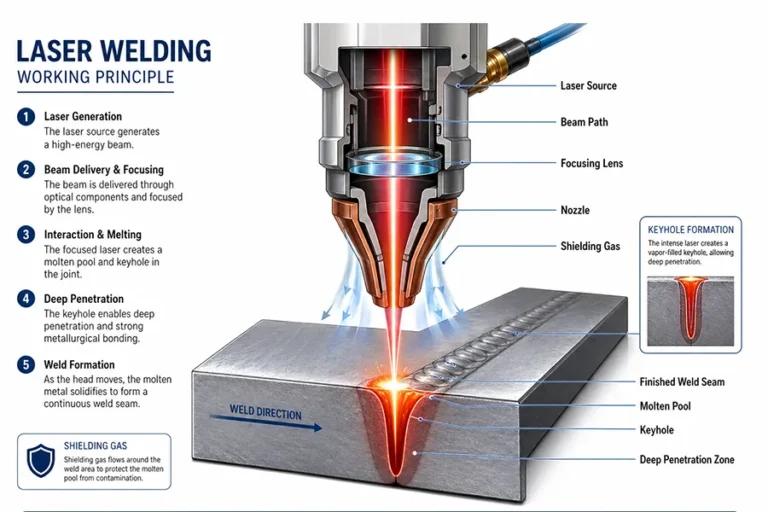
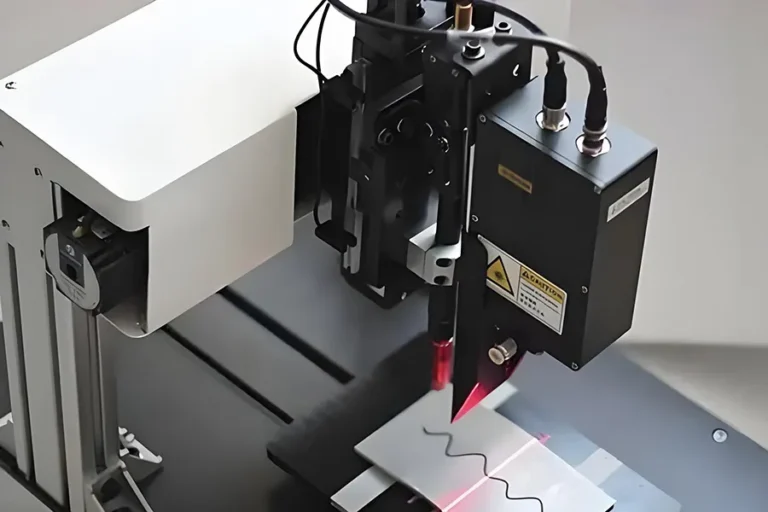
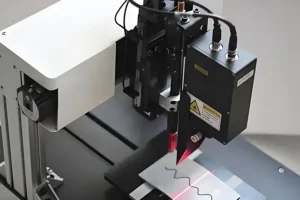
Laser welding is a fusion welding process that uses a laser beam as the heat source. Its working principle is as follows: the active medium is excited by a specific method, causing it to oscillate back and forth within the resonant cavity, thereby converting it into a stimulated radiation beam. When this beam contacts the workpiece, its energy is absorbed by the workpiece. Once the temperature reaches the material’s melting point, welding can be performed.
Based on the mechanism of weld pool formation, laser welding can be divided into two fundamental welding mechanisms: heat conduction welding and deep penetration (keyhole) welding. In heat conduction welding, the generated heat diffuses into the interior of the workpiece through thermal conduction, causing the surface of the weld to melt without significant vaporization. This method is commonly used for welding low-speed, thin-walled components. Deep penetration welding vaporizes the material, producing a large amount of plasma. Due to the high heat input, a keyhole phenomenon occurs at the leading edge of the weld pool. Deep penetration welding can fully penetrate the workpiece, and with its high energy input and fast welding speed, it is currently the most widely used mode of laser welding.
3. Main Process Parameters of Laser Welding
Numerous process parameters affect the quality of laser welding, such as power density, laser pulse waveform, defocus amount, welding speed, and auxiliary shielding gas.
3.1 Laser Power Density
Power density is one of the most critical parameters in laser processing. Using a higher power density allows the surface layer to be heated to the boiling point within microseconds, resulting in substantial vaporization. Therefore, high power density is highly advantageous for material removal processes such as drilling, cutting, and engraving. With lower power densities, it takes several milliseconds for the surface temperature to reach the boiling point. Before surface vaporization occurs, the underlying layer reaches the melting point, facilitating the formation of a sound fusion weld. Consequently, in heat conduction laser welding, the power density range is typically between 10⁴ and 10⁶ W/cm².
3.2 Laser Pulse Waveform
The laser pulse waveform is both an important parameter for distinguishing between material removal and material melting, and a key parameter determining the size and cost of processing equipment. When a high-intensity laser beam irradiates the material surface, 60-90% of the laser energy can be reflected and lost, particularly for materials such as gold, silver, copper, aluminum, and titanium, which have high reflectivity and rapid heat conduction. During a laser pulse, the reflectivity of the metal changes over time. When the material surface temperature rises to the melting point, the reflectivity decreases rapidly. Once the surface is in a molten state, the reflectivity stabilizes at a certain value.
3.3 Laser Pulse Width
Pulse width is an important parameter in pulsed laser welding. It is determined by the required penetration depth and heat-affected zone. The longer the pulse width, the larger the heat-affected zone, and the penetration depth increases with the square root of the pulse width. However, increasing the pulse width reduces the peak power. Therefore, it is generally used in heat conduction welding, resulting in a wide and shallow weld seam, which is particularly suitable for lap welding of thin and thick plates. Nevertheless, a lower peak power can lead to excessive heat input. Each material has an optimal pulse width that maximizes the penetration depth.
3.4 Defocus Amount
Laser welding typically requires a certain amount of defocusing because the power density at the center of the laser spot at the focal point is excessively high, making it prone to evaporation and hole formation. On planes away from the laser focal point, the power density distribution is relatively uniform.
There are two methods of defocusing:
Positive defocus and negative defocus. Positive defocus occurs when the focal plane is located above the workpiece, while negative defocus occurs when it is below. According to geometrical optics theory, when the distances from the positive and negative defocus planes to the welding plane are equal, the power density on the corresponding planes is approximately the same. However, in practice, the shapes of the resulting molten pools differ to some extent. With negative defocus, a greater penetration depth can be achieved, which is related to the weld pool formation process.
3.5 Welding Speed
The welding speed determines weld surface quality, penetration depth, heat-affected zone, and other characteristics. The speed affects the heat input per unit time. If the welding speed is too slow, the heat input will be too high, causing the workpiece to burn through. If the welding speed is too fast, the heat input will be too low, resulting in incomplete penetration. Usually, reducing the welding speed is employed to increase the penetration depth.
3.6 Auxiliary Shielding Gas Blowing
Assistive shielding gas blowing is an essential process in high-power laser welding. On one hand, it prevents splashes of molten metal from contaminating the focusing lens; on the other hand, it prevents excessive plasma generated during welding from focusing and blocking the laser from reaching the material surface. During laser welding, gases such as helium, argon, and nitrogen are often used to shield the molten pool, protecting the workpiece from oxidation. Factors such as the type of shielding gas, gas flow rate, and blowing angle significantly impact the welding results, and different blowing methods can also affect weld quality to some extent.
Helium is not easily ionized (it has a high ionization energy), allowing the laser to pass through smoothly and the beam energy to reach the workpiece surface unimpeded. It is the most effective shielding gas used in laser welding, but it is relatively expensive.
Argon is relatively inexpensive and has a higher density, providing better protection. However, it is prone to ionization by high-temperature metal plasma, which shields part of the beam from reaching the workpiece, reducing the effective laser power for welding and also impairing welding speed and penetration depth. The surface of the weldment protected by argon is typically smoother than that protected by helium.
Nitrogen is the cheapest shielding gas, but it is unsuitable for welding certain types of stainless steel, mainly due to metallurgical issues such as nitrogen absorption, which can sometimes lead to pore formation in the overlap joint area.
4. Conclusion
Laser welding, as a novel welding technology, is characterized by high energy density, high speed, high precision, deep penetration, and strong adaptability. Its application scope is becoming increasingly extensive. It not only enhances production efficiency but also improves welding quality. As technology continues to advance, laser welding technology is certain to play an even more significant role in the field of material processing.