

In the field of automation equipment, actuators have always been critical components for enhancing efficiency and stability. Pneumatic cylinders, valued for their low cost and rapid response, were once the mainstay of production lines; however, electric cylinders are increasingly coming to the fore thanks to their high precision and superior controllability.
So, in today’s landscape—where efficiency, precision, and stability are paramount—which one truly takes the lead?
1. Response Speed vs. Control Precision
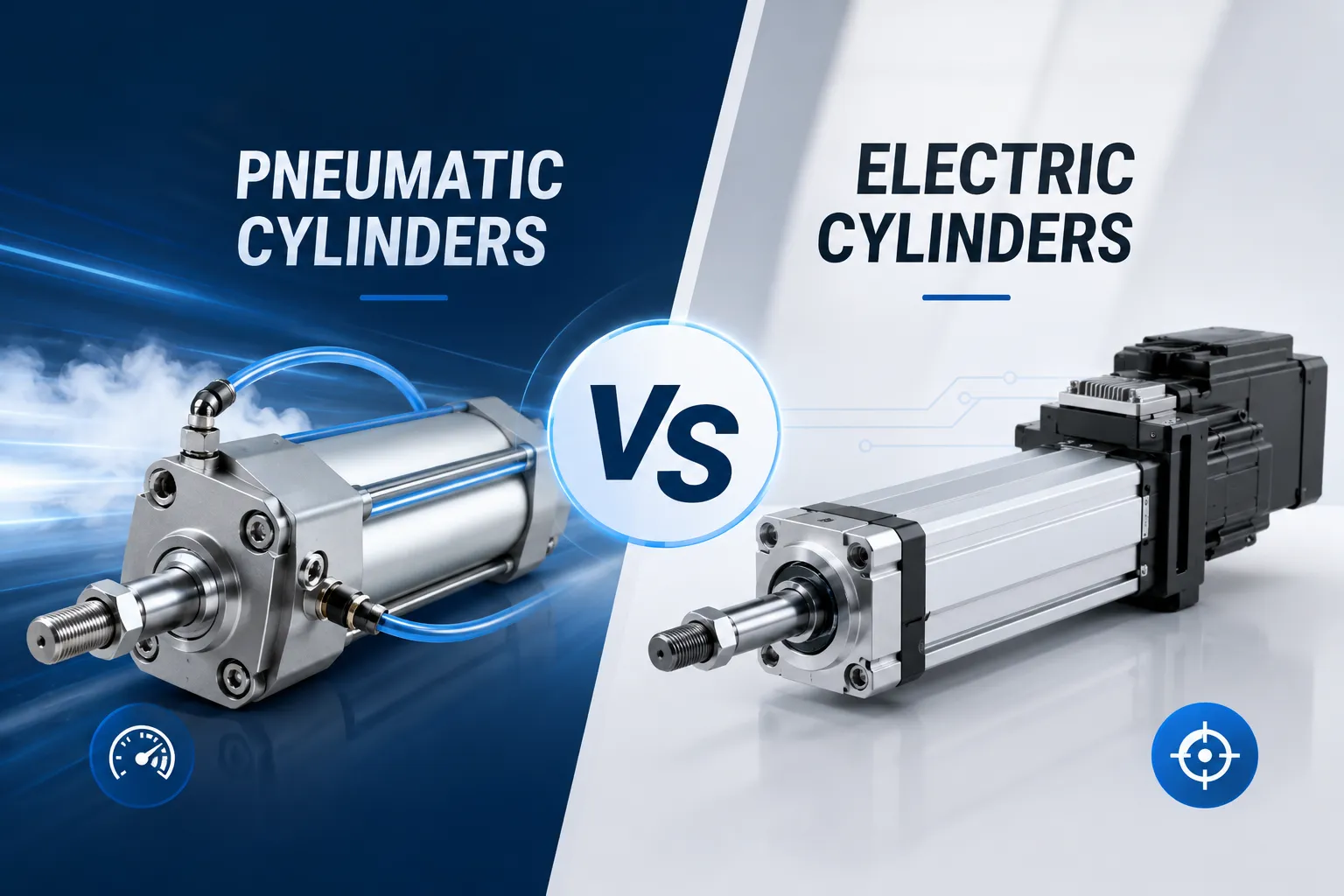
Pneumatic cylinders: Driven by compressed air; they act quickly but are susceptible to fluctuations in the air supply, with repeatable positioning accuracy typically ranging from ±0.1 to 0.2 mm.
Electric cylinders: Utilize a servo motor and lead screw structure; response is slightly slower, but precision can be maintained at ±0.01 mm or even higher.
Summary: Choose pneumatic cylinders when speed is the priority; choose electric cylinders when precision is the priority.
2. Controllability vs. Programmability
Pneumatic cylinders: Generally limited to simple “extend” and “retract” motions, offering limited position control.
Electric cylinders: Support arbitrary position control, speed adjustment, and thrust feedback, integrating easily with PLCs or servo systems.
Summary: Electric cylinders clearly excel in scenarios requiring complex movements or electronic control.
3. Maintenance Costs and Lifespan
Pneumatic cylinders: Require a continuous air supply, are vulnerable to air source contamination, and have seals with a short lifespan.
Electric cylinders: Feature excellent structural sealing, require no air supply, offer a long service life, and demand minimal maintenance.
Summary: Electric cylinders demonstrate a distinct cost advantage over the long term.
4. Application Scenarios
Pneumatic cylinders: Suitable for low-cost applications such as clamping, positioning, and simple linear motion.
Electric cylinders: Suitable for high-end applications such as high-precision transfer, workpiece press-fitting, multi-point control, and force-controlled testing.
5. Price Comparison: Cheaper Isn’t Always Better
Although the unit price of an electric cylinder is higher than that of a pneumatic cylinder, the electric cylinder offers a lower Total Cost of Ownership (TCO) when factoring in system integration, operating costs, and long-term maintenance.
As automation moves toward greater flexibility and intelligence, electric cylinders—with their advantages of high precision, robust control, and low maintenance—are gradually replacing traditional pneumatic cylinders and becoming the preferred choice for an increasing number of high-end manufacturing enterprises.