

Food Production Equipment: Five Essential Categories
In the food manufacturing industry, selecting the right food production equipment is pivotal to streamlining workflows, ensuring product quality, and meeting regulatory standards. From raw material preparation to final storage, each production stage relies on specialized machinery tailored to specific needs. Below is a detailed breakdown of the five essential categories of food production equipment, designed to guide B2B buyers and food processing businesses in making informed decisions.
1. Pretreatment Food Production Equipment
Pretreatment is the foundational step in food processing, and dedicated food production equipment in this category ensures raw materials meet safety and quality prerequisites for subsequent stages.
Key Functions
This equipment focuses on cleaning impurities and classifying raw materials. It removes soil, pesticide residues, and foreign matter from fruits, vegetables, meat, and aquatic products, while sorting items by size, weight, color, or quality to maximize material utilization.
Equipment Types & Selection
– Cleaning machines: Small workshops can opt for compact drum cleaning machines (cost-effective), while large-scale factories benefit from bubble cleaning machines that save labor and water over the long term.
– Sorting/grading equipment: Conveyor-based sorters suit small processing volumes, while optical sorters (with 0.1mm precision) and dynamic weight sorters (±1g accuracy, 300 pieces/minute) are ideal for fruits, vegetables, aquatic products, poultry, and seafood—adapting to both regular and irregular raw materials.
2. Food Safety Testing Equipment
Ensuring food safety is non-negotiable, and food safety testing equipment plays a critical role in screening foreign objects and monitoring hygiene indicators throughout production.
Key Functions
This category encompasses two core capabilities: foreign object detection (e.g., metal, stones, glass) and quality inspection (e.g., detecting inferior or impure components), safeguarding product safety and compliance.
Equipment Types & Selection
– Metal detectors: Economical options (affordable for small plants) effectively detect metallic contaminants, suitable for businesses with basic safety requirements.
– X-ray foreign object detectors: High-precision models (down to 0.05mm accuracy) identify tiny non-metallic impurities like stones and glass. They offer fast detection speeds (hundreds of pieces per minute), image recognition, and data recording for traceability—ideal for enterprises with strict quality control needs.
3. Processing Equipment
Processing equipment is the core of food production, transforming raw materials into semi-finished or finished products through physical or thermal processing.
Key Functions
It covers four main processes: cutting/crushing (shaping raw materials), mixing/blending (achieving uniform textures), cooking/baking (maturing ingredients), and molding (giving products their final form).
Equipment Types & Selection
– Cutting/crushing: Vegetable cutters, meat slicers, and grinders.
– Mixing/blending: Dough mixers and sauce blenders.
– Cooking/baking: Steam jacketed kettles and ovens.
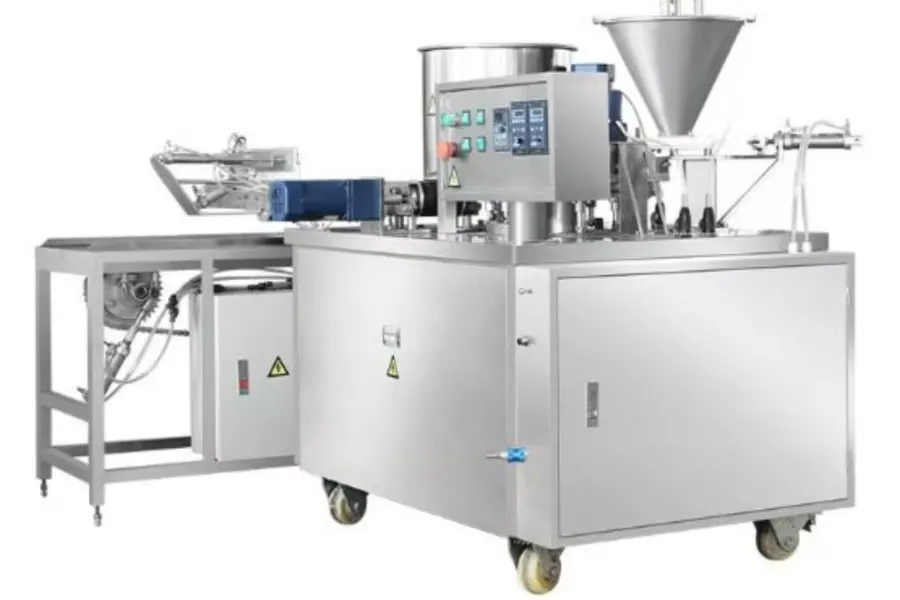
– Molding: Biscuit or candy forming machines. Small catering businesses can choose commercial-grade equipment, while large factories require professional large-scale machinery to match high production volumes.
4. Packaging Equipment
Packaging equipment ensures product freshness, extends shelf life, and enables accurate labeling—critical for product distribution and consumer trust.
Key Functions
This category includes filling/sealing (quantitatively packaging liquids, pastes, or solid products) and labeling (marking product information like ingredients, expiration dates, and certifications).
Equipment Types & Selection
– Filling/sealing machines: Liquid/paste filling machines, capping machines, and heat sealers.
– Labeling machines: For applying product information labels. Selection depends on production scale: manual equipment for small factories, semi-automatic models for medium enterprises, and fully automatic production lines for large-scale operations (enabling unmanned automation).
5. Storage Equipment
Proper storage preserves product quality, and storage equipment is categorized by temperature control needs to accommodate different food types.
Key Functions
It provides two core storage solutions: temperature-controlled storage (maintaining freshness of fresh or frozen foods) and room-temperature storage (housing dry goods, canned products, etc.).
Equipment Types & Selection
– Temperature-controlled storage: Refrigerated warehouses for fresh/frozen foods; display cabinets for small stores.
– Room-temperature storage: Angle steel shelves for small supermarkets; heavy-duty pallet racks for large warehouses (priced based on size and material).
Key Considerations for Choosing Food Production Equipment
When investing in food production equipment, B2B buyers should prioritize four factors:
– Production scale: Small enterprises focus on cost-effective standalone equipment; large businesses can adopt automated production lines.
– Food type: Fresh products require cold chain equipment; processed foods need machinery matching specific processes (e.g., frying, baking).
– Compliance: Equipment must meet food safety standards (e.g., stainless steel materials, easy-to-clean designs); export-oriented businesses need to comply with international certifications like HACCP and FDA.
– Intelligence level: Automated equipment (e.g., linked production lines, smart testing systems) enhances efficiency and reduces labor costs.
Conclusion
The five categories of food production equipment—pretreatment, testing, processing, packaging, and storage—form the backbone of a seamless food manufacturing workflow. For B2B food businesses, understanding the functions and selection criteria of each category is essential to building a efficient, compliant, and scalable production line. By aligning equipment choices with production scale, food type, and quality requirements, you can leverage food production equipment to elevate product consistency, meet market demands, and gain a competitive edge in the industry.