
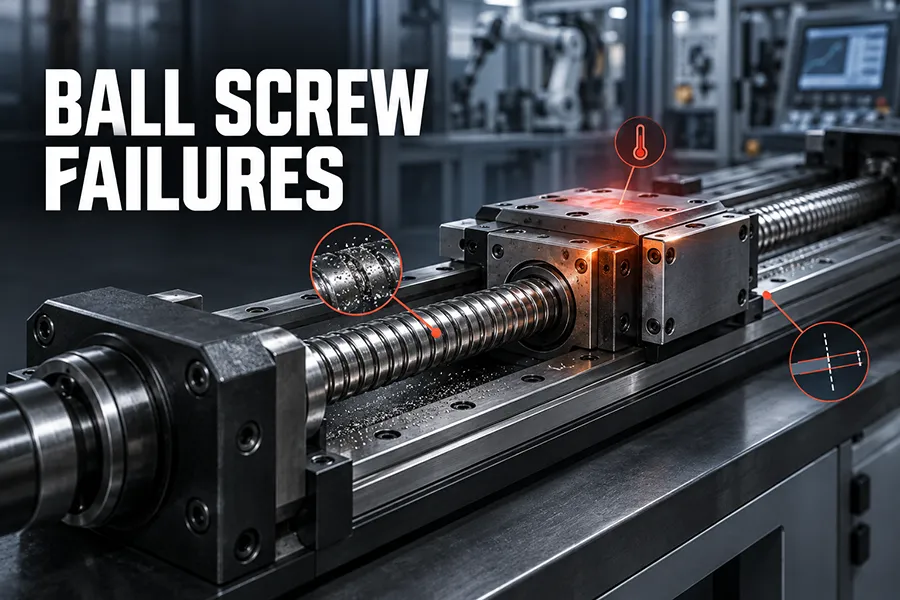
Today, let’s discuss several common operating mistakes that can lead to ball screw failures.
“Why does my ball screw module start making strange noises after only a short period of use?”
“Why was the precision excellent at first, but then gradually deteriorated?”
“Is the quality of your modules poor?”
These are questions customers frequently ask when seeking after-sales support. In reality, the problem often does not lie with the module itself.
1. Long-term operation under excessive load
This is one of the most common issues.
Many customers find no problems during initial testing when designing their equipment. However, once the equipment enters mass production, they often increase the product weight or operating speed to boost efficiency.
The result: a module rated for a 50 kg load ends up carrying 70 kg or more for extended periods.
The module might function normally in the short term. Over time, however, the ball screw, linear guide rails, and slider undergo accelerated wear, leading to issues such as abnormal noise, rising temperatures, unstable operation, and a loss of precision.
Therefore, the actual load must be kept within the module’s rated capacity. A safety margin should be factored in during the selection process to avoid operating the module at its load limit for extended periods.
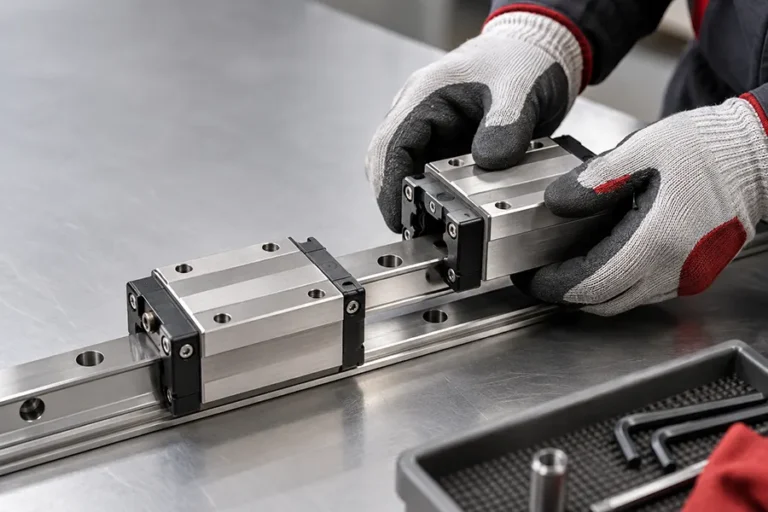
2. Inadequate installation precision
Some customers believe: “As long as the module is securely mounted and runs, that’s enough.”
This is a misconception.
If the mounting surface is uneven, the base is deformed, or parallelism and perpendicularity are not properly adjusted during multi-axis assembly, the module will encounter extra resistance during operation.
Poor installation precision can lead to:
- Increased operating resistance;
- Abnormal noise and vibration;
- Higher motor load;
- Uneven wear on the ball screw and guide rails;
- Gradual loss of positioning accuracy;
- Reduced service life of the module.
Before installation, ensure the mounting surface is flat, clean, and free of burrs. For multi-axis systems, carefully adjust the parallelism, perpendicularity, and coaxiality between the axes.
3. Subjecting the ball screw module to lateral forces
Ball screw modules are designed primarily for linear motion.
However, off-center mounting, placing the load’s center of gravity too far from the carriage, or subjecting the module to lateral impacts can place additional stress on the guide rails, slider, and ball screw. These lateral forces and overturning moments cause uneven loading on the guide rails and slider blocks. Prolonged operation can lead to abnormal wear, vibration, a decline in precision, and even damage to internal components.
When designing equipment, the load’s center of gravity should be kept as close as possible to the center of the slide unit. If the application involves significant lateral forces or overturning moments, auxiliary supports should be added, or a module with higher rigidity and load-bearing capacity should be selected.
4. Harsh Operating Environment
Dust, metal chips, welding spatter, moisture, and other contaminants can all affect the service life of a ball screw module.
If these foreign objects enter the module, they can contaminate the grease, scratch the guide rail surfaces, damage the ball recirculation system, and increase operating resistance.
Different operating environments require different protective structures, such as:
- Bellows-style protective covers;
- Dust-proof cover plates;
- Sealed structures;
- Corrosion-resistant components;
- Regular cleaning and inspection.
In environments with high levels of dust or debris—such as machining, welding, or woodworking—standard open-style modules often fail to provide adequate protection; therefore, dust-proofing and sealing designs must be considered from the outset.
5. Use Without Maintenance
Ball screw modules contain ball screws and linear guides; these precision components require regular lubrication.
During prolonged high-speed operation, inadequate lubrication leads to increased internal friction and rising temperatures. This results in increased noise, accelerated wear, and a gradual decline in positioning accuracy.
Lubrication intervals should not be fixed; they should be adjusted based on operating speed, load, the working environment, and daily operating hours.
Routine maintenance primarily includes:
- Checking the lubrication status;
- Periodically applying appropriate grease;
- Cleaning exposed module components;
- Checking for abnormal noise or vibration;
- Inspecting mounting bolts and couplings;
- Monitoring for changes in positioning accuracy.
Proper preventive maintenance can effectively reduce unexpected downtime and future repair costs.
6. Incorrect Initial Selection
Problems with ball screw modules often stem from issues during the initial selection phase.
Forcing a small-specification module to handle heavy loads, using a standard module for high-precision applications, or choosing an unsuitable structure for high-speed operations can all lead to unstable performance and premature failure. When selecting automation equipment, there is no single “best” product; there is only the solution best suited to the actual operating conditions.
Before selecting a ball screw module, you must verify the following:
- Effective stroke;
- Operating speed;
- Actual load;
- Positioning accuracy;
- Repeat positioning accuracy;
- Mounting orientation;
- Center of gravity of the load;
- Operating environment;
- Daily operating hours.
These parameters should be confirmed prior to equipment design and installation to avoid discovering—only after the equipment is fully assembled—that the module is unsuitable for the actual operating conditions.
Summary
Many issues with ball screw modules do not stem from poor product quality.
More often, problems arise from incorrect selection, improper installation, long-term operation beyond rated limits, unsuitable operating environments, or a lack of timely maintenance.
For automation equipment to operate stably over the long term, the selection of drive components and the way they are used are equally critical.