

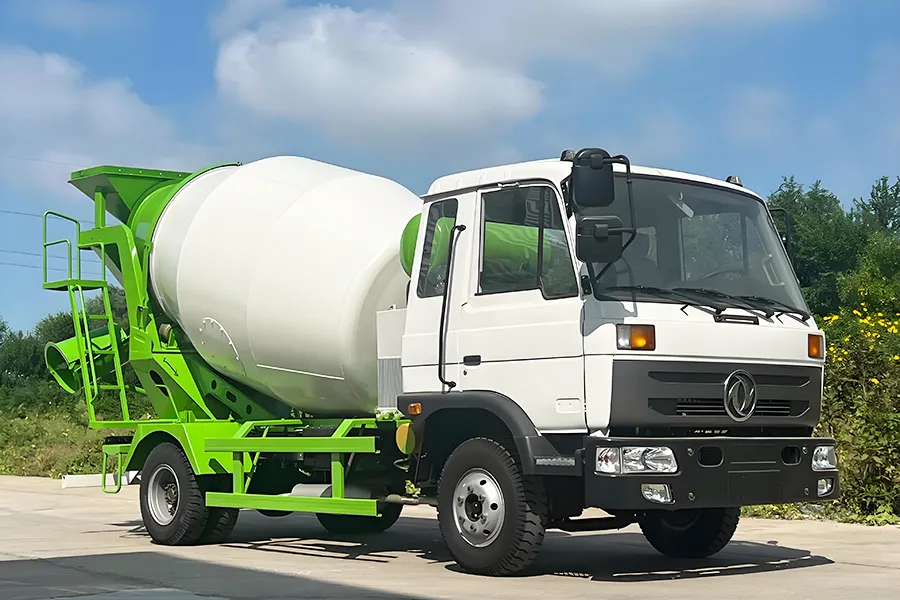
Concrete is one of the most commonly used and crucial building materials in modern construction engineering, road construction, and various infrastructure projects. Concrete mixer trucks are responsible not only for transporting ready-mixed concrete from the batching plant to the construction site, but also for preventing segregation and hardening of the concrete through continuous mixing, ensuring good workability during pouring.
1. Working Principle
A concrete mixer truck is a mechanical device that mixes cement, sand, aggregate, and water to produce concrete mixture, playing a crucial role in the construction process. The working principle of a concrete mixer truck is to maintain the uniformity of the concrete by rotating the mixing drum.
1.1 Mixing Stage (Forward Rotation)
During transportation, the mixing drum rotates forward, and the internal spiral blades continuously lift and tumble the concrete, ensuring fluidity and uniformity, and preventing segregation or premature setting.
1.2 Discharge Stage (Reverse Rotation)
Upon arrival at the construction site, the mixing drum rotates in reverse, and the spiral blades push the concrete towards the outlet, which is then guided to the pouring point through the guide chute.
1.3 Cleaning Stage
After operation, the inner wall of the mixing drum needs to be cleaned with water to prevent residual concrete from hardening and affecting future use.
The continuous mixing and mechanical structure of the mixer truck make it a key piece of equipment for ensuring concrete quality.
2. Structure of a Concrete Mixer Truck
A concrete mixer is a powerful assistant on a construction site, and its efficient operation relies on the close cooperation of several key components. Let’s take a look at these indispensable components!
2.1 Mixing Unit
This is the “heart” of the mixer, consisting of the mixing drum, mixing shaft, mixing blades, and shaft end seals. The mixing drum is integrally welded and contains 12 side liners and 77 arc-shaped liners, which are securely connected to the drum body with countersunk screws. Because the contact degree between the aggregate and the liners varies, the wear degree of the liners will also vary, so they can be interchanged to extend their service life.
2.2 Water Supply System
The water supply system of the concrete mixer consists of a motor, water pump, throttle valve, cleaning device, and spray pipes. The water pump delivers water to the spray pipes through the throttle valve, which regulates the water flow to ensure the accuracy of concrete mixing.
2.3 Transmission System
The transmission system is the “bloodline” of the mixer, mainly composed of a motor, mixing gearbox, coupling, and mixing shaft. The motor is directly mounted on the end face of the chassis and drives the mixing shaft to rotate through gears and a linkage device, thereby achieving uniform mixing of concrete.
3. Common Classifications
There are many types of concrete mixer trucks. The appropriate mixer should be selected based on different operational needs. The three common types of concrete mixers are as follows:
3.1 Forced Mixer
A forced mixer consists of a drum, frame, motor, reducer, rotating arm, mixing shovel, and cleaning scraper. Two horizontal mixing shafts inside the mixing drum rotate, driving the mixing arms and blades on the shafts to forcibly mix various materials entering the mixing chamber. It is often used to mix dry-hard concrete and lightweight aggregate concrete.
3.2 Gravity Mixer
A gravity mixer uses the rotation of the mixing drum to allow materials to fall freely, thus mixing them. The mixing drum rotates at an appropriate speed. Gravity mixers first appeared in the early 20th century and have a long history. They are often used to mix general plastic concrete and have the widest range of applications, suitable for both decentralized and centralized use on construction sites.
3.3 Automatic Feeding Mixer
An automatic feeding concrete mixer automatically fills the mixing hopper with the required materials for mixing. Common feeding methods include tilting feeding and bucket feeding, which are intuitive and easy to operate and observe.
4. Application Scenarios
- Urban Construction Projects: Such as building construction and commercial center construction, which require large quantities of concrete and a stable supply.
- Road and Bridge Construction: Large-area pouring requires continuous supply, and mixer trucks ensure that concrete arrives at the construction site on time.
- Infrastructure Construction: Such as water conservancy projects, airport runways, tunnels, subways, etc.
- Precast Component Plants: Used to transport ready-mixed concrete to the production line.
Almost all engineering fields involving concrete rely on mixer trucks.
5. Precautions During Mixer Use
- The concrete mixer truck must be supported by a bracket and placed on a stable surface.
- Before using the mixer, it should be inspected to ensure that the equipment controller and components are in good working order before normal operation. 3. There must be no foreign objects inside the mixer drum, otherwise it will affect the subsequent mixing effect.
- For safety reasons, when the mixer rises into the hopper, no personnel are allowed to pass through or stay under the hopper; tools must not be inserted into the mixing drum while the mixer is running.
- If on-site maintenance is required, the mixer hopper must be secured, and the power must be disconnected before maintenance can be carried out. If entry into the mixing drum is necessary, someone must be present outside to supervise.
Summary
A concrete mixer truck is a specialized engineering vehicle that integrates transportation and mixing functions. It maintains the freshness and homogeneity of concrete through a continuously rotating mixing drum. Its high efficiency, safety, and stability make it widely used in construction engineering, road construction, bridge pouring, and other fields, making it an indispensable piece of equipment in modern concrete engineering.