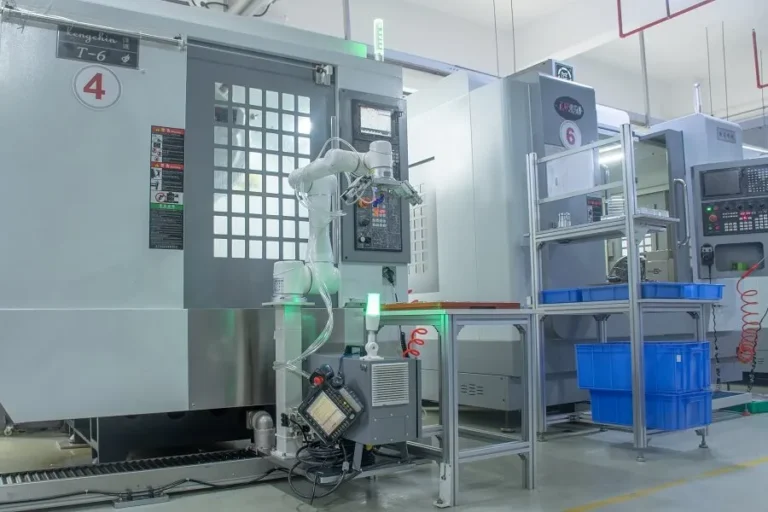

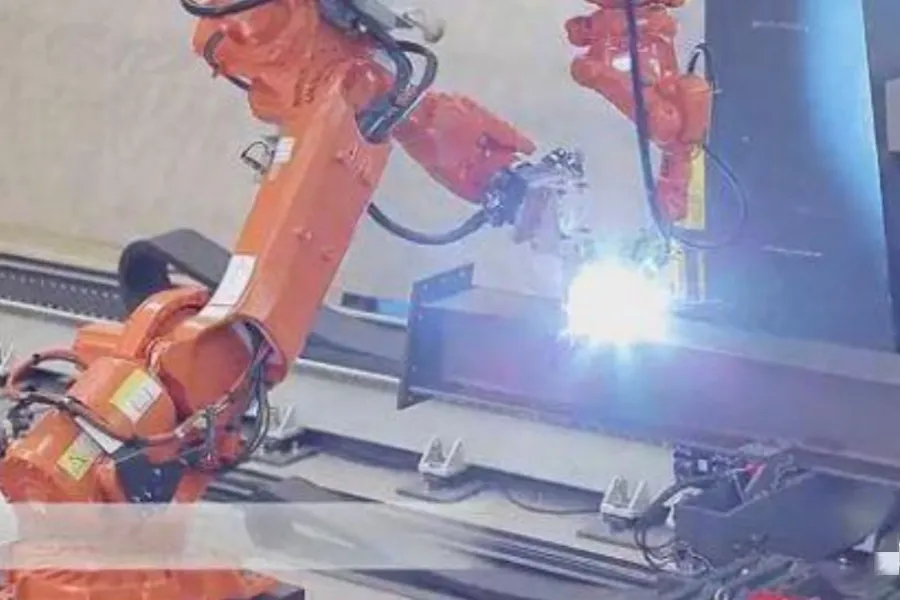
1. System Composition of Robotic Arc Welding
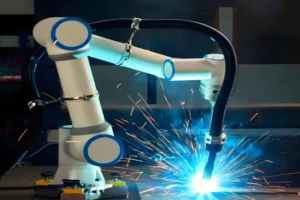
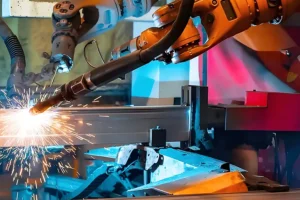
- Robot
- Automatic wire feeding device
- Welding power supply
- Welding torch
- Positioner
- Fixture
- Torch cleaning and wire cutting device
- Cooling water tank
- Flux delivery and recovery device (for SAW)
- Mobile device
- Welding positioner
- Sensing device
- Dust removal device and weld inspection equipment
2. Three Welding Methods for Robotic Arc Welding
2.1 Gas Shielded Arc Welding
2.2 Tungsten Inert Gas (TIG) Welding
2.3 Plasma Arc Welding
3. Three Gas Shielded Welding Methods for Robotic Arc Welding
3.1 MIG Welding (Metal Inert Gas Arc Welding)
3.2 TIG Welding (Tungsten Inert Gas Shielded Welding)
3.3 MAG Welding (Metal Active Gas Shielded Welding)
4. Explanation of Robotic Arc Welding Systems
5. Arc Welding Current in Debugging
- Small current:
Narrow weld bead, shallow penetration, easy to form excessive height, incomplete fusion, incomplete penetration, slag inclusion, porosity, electrode adhesion, arc breakage, failure to ignite arc, etc.; - Large current:
Wide weld bead, deep penetration, undercut, burn-through, shrinkage cavity, large spatter, overburning, large deformation, weld lump, etc.
6. Offline Programming
7. Two Key Technologies of the System
- Coordinated control technology:
Control the coordinated movement of multiple robots and positioners, which can not only maintain the relative posture of the welding torch and the workpiece to meet the requirements of the welding process, but also avoid collision between the welding torch and the workpiece, and control the deformation impact of the welding area of each robot. - Precise weld trajectory tracking technology:
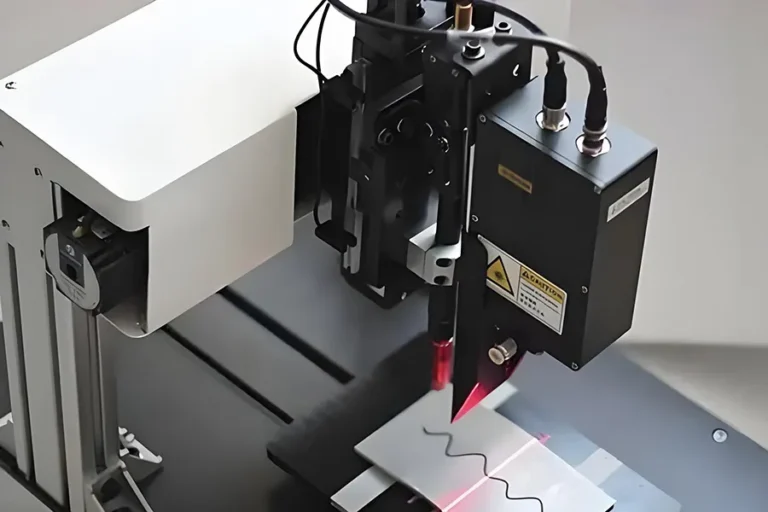
Combine the advantages of the offline working methods of laser sensors and vision sensors, use laser sensors to realize weld tracking during the welding process, improve the flexibility and adaptability of welding robots for welding complex workpieces, and combine vision sensors to observe offline to obtain the residual deviation of weld tracking. Based on deviation statistics, obtain compensation data and correct the robot’s movement trajectory, so as to obtain the best welding quality under various working conditions.
8. Welding Power Supply
-
Welding power supply
Consumable electrode gas shielded welding usually uses a DC welding power supply, and the arc welding rectifier-type DC power supply is widely used in production at present. In recent years, inverter-type arc welding power supplies have also developed rapidly. The rated power of the welding power supply depends on the current range required for various applications. The current required for consumable electrode gas shielded welding is usually between 100-500A, the duty cycle of the power supply is in the range of 60%-100%, and the no-load voltage is in the range of 55-85V.
-
External characteristics of welding power supply
The welding power supply for consumable electrode gas shielded welding can be divided into three types according to the type of external characteristics: flat characteristic (constant voltage), steep drop characteristic (constant current), and gentle drop characteristic.
(1) Flat characteristic
When the shielding gas is inert gas (such as pure Ar), Ar-rich gas, and oxidizing gas (such as CO₂), and the wire diameter is less than φ1.6mm, flat characteristic power supplies are widely used in production. This is because flat characteristic power supplies have many advantages when matched with constant-speed wire feeders: the arc voltage can be adjusted by changing the no-load voltage of the power supply, and the welding current can be adjusted by changing the wire feed speed, so the welding specification adjustment is relatively convenient. When using this external characteristic power supply, it has a strong self-adjustment effect when the arc length changes; at the same time, the short-circuit current is large, and arc ignition is relatively easy. The external characteristics of the flat characteristic power supplies actually used are not all truly flat, but have a certain downward slope, and the downward slope rate is generally not more than 5V/100A, but they still have the above advantages.
(2) Drop characteristic
When the wire diameter is relatively thick (greater than φ2mm), drop characteristic power supplies are generally used in production, matched with variable-speed wire feed systems. Since the wire diameter is relatively thick, the self-adjustment effect of the arc is weak, and the recovery speed after arc length change is slow. It is difficult to ensure a stable welding process relying solely on the self-adjustment effect of the arc. Therefore, like general submerged arc welding, an additional arc voltage feedback circuit is required to timely feed back the change of arc voltage (arc length) to the wire feed control circuit, adjust the wire feed speed, so that the arc length can be restored in time.
- Adjustment of power supply output parameters
The main technical parameters of consumable electrode gas shielded welding power supplies are:(1) Input voltage (number of phases, frequency, voltage)(2) Rated welding current range(3) Rated duty cycle (%)
(4) No-load voltage
(5) Load voltage range
(6) Type of power supply external characteristic curve (flat characteristic, gentle drop external characteristic, steep drop external characteristic)
(1) Arc voltage
Arc voltage refers to the voltage drop between the end of the wire and the workpiece, not the voltage indicated by the power supply voltmeter (the voltage at the output end of the power supply). The pre-adjustment of arc voltage is realized by adjusting the no-load voltage of the power supply or the slope of the power supply external characteristic. Flat characteristic power supplies mainly realize arc voltage adjustment by adjusting the no-load voltage. Gentle drop or steep drop characteristic power supplies mainly realize arc voltage adjustment by adjusting the slope of the external characteristic.
(2) Welding current
The current of flat characteristic power supplies is mainly adjusted by adjusting the wire feed speed, and sometimes the no-load voltage is appropriately adjusted for a small amount of current adjustment. For gentle drop or steep drop characteristic power supplies, it is mainly realized by adjusting the slope of the power supply external characteristic.
9. Wire Feeding System
The wire feeding system is usually composed of a wire feeder (including motor, reducer, straightening wheel, wire feeding wheel, wire feeding hose, wire spool, etc.). The wire coiled on the wire spool is sent to the welding torch through the straightening wheel and wire feeding wheel. According to different wire feeding methods, it can be divided into four types:
(1) Push-type
Push-type refers to the wire being pushed by the wire feeding wheel through the hose to reach the welding torch, which is the main wire feeding method for semi-automatic consumable electrode gas shielded welding.
(2) Pull-type
Pull-type can be divided into three forms:
- Separate the wire spool and the welding torch, and connect them through a wire feeding hose;
- Install the wire spool directly on the welding torch;
- Separate the wire spool from the welding torch, and also separate the wire feeding motor from the welding torch.
(3) Push-pull type
The wire feeding hose of this wire feeding method can be extended up to about 15m, expanding the operating distance of semi-automatic welding. When the wire advances, it relies on both the thrust from the back and the pulling force from the front, using the combined force of the two to overcome the resistance of the wire in the hose. The two powers of push and pull need to be coordinated during debugging, and try to be synchronized, but pull is the main one. During wire feeding, the wire should always be kept straight in the hose.
(4) Planetary (linear) type
The planetary wire feeding system is designed based on the principle that “a rotating nut fixed axially can feed a screw axially”.
10. Welding Torch
- Classification of welding torches
(1) Semi-automatic welding torchesSemi-automatic welding torches usually have two forms: gooseneck type and pistol type.
- Gooseneck type welding torch
Suitable for small-diameter wires, flexible and convenient to use, especially suitable for welding in compact parts, hard-to-reach corners, and some restricted areas; - Pistol type welding torch
Suitable for larger-diameter wires, it has higher requirements for cooling effect, so internal circulating water cooling is often used. Semi-automatic welding torches can be installed together with the wire feeding mechanism or separated.
(2) Automatic welding torches
The basic structure of automatic welding torches is the same as that of semi-automatic welding torches, but they have a larger current-carrying capacity and longer working time, and sometimes need to use internal circulating water cooling. The welding torch is directly installed at the lower part of the welding head, and the wire is sent into the welding torch through the wire feeding wheel and wire guide tube.
- Gas supply system and cooling water system
(1) Gas supply systemThe gas supply system is similar to that of tungsten inert gas welding. For CO₂ gas, a preheater and dryer usually need to be installed to absorb moisture in the gas and prevent porosity from forming in the weld. For consumable electrode active gas shielded welding, a gas mixing device also needs to be installed to mix the gas evenly before sending it into the welding torch.
(2) Cooling water system
The cooling water system is composed of a water tank, a water pump, a cooling water pipe, and a water pressure switch. The cooling water in the water tank flows through the cooling water pipe via the water pump, enters the welding torch after passing through the water pressure switch, and then flows back into the water tank through the cooling water pipe to form a cooling water cycle. The function of the water pressure switch is to ensure that the welding system cannot start welding when cooling water does not flow through the welding torch, so as to protect the welding torch and avoid burning due to no cooling.
- Torch service center
Including torch cleaning and wire cutting device, oiling device, and TCP automatic calibration device. It can increase the normal operation time by 8%.
- Automatic TCP definition
- Automatic TCP inspection/update
- TCP repeatability +/- 0.1mm
- Stable workpiece quality
Higher system reliable operation time
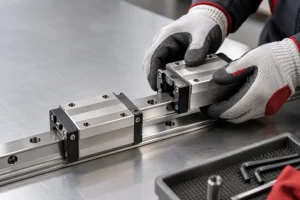
11. Positioner
12. Starting Point Sensing Function
- Pre-weld contact sensing;
- Automatically search for weld start point, end point, and weld position;
- Reduce the positioning accuracy requirements for fixtures;
- Can realize 3D guidance;
- Fast search, search speed 20-50mm/s, single-point one-direction search time 2-6s;
- Guidance accuracy ±0.25mm.
13. Arc Tracking and Adaptive Function
- Automatically track the weld during the welding process;
- Use the arc as a sensing device;
- Assembly, processing, and welding deformation errors can be corrected;
- Weld tracking accuracy ±0.1mm.
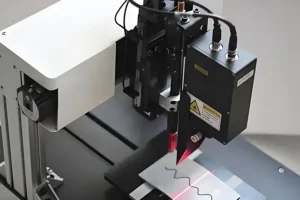
14. Laser Vision Weld Sensing
- Real-time acquisition of torch position and welding speed, convenient control, and easy adjustment when the speed changes.
- Can be easily integrated and synchronized with external axes
- Bus communication method, rich information volume