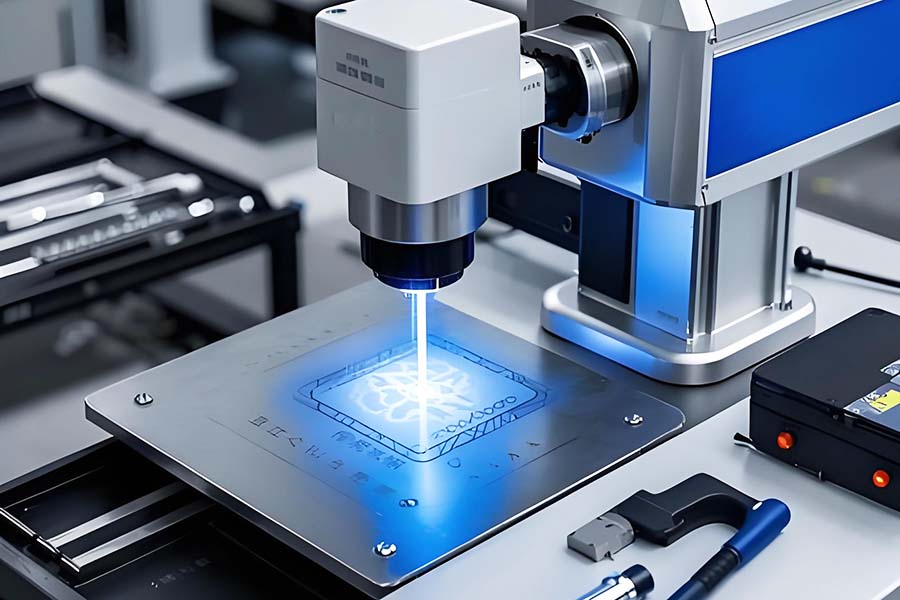
Different types of laser marking machines produce varying marking effects on different materials. Different industries also require different types of laser marking machines, primarily based on the material’s absorption of the incident laser. This determines whether the material is suitable for marking. To achieve the best marking results for a wide variety of materials, different laser marking machines can be selected. Only by choosing the correct laser wavelength can the advantages of the laser marking machine be fully utilized to complete the marking task.
1. Types of Laser Marking Machines
1.1 CO2 Laser Marking Machine
Laser wavelength is 10.64µm. Primarily used for marking non-metallic materials such as leather, fabric, wood, bamboo products, plastics, rubber, and PVC.
1.2 Fiber Laser Marking Machine
Wavelength is 1064nm. Primarily used for marking metallic materials, and can also be used for marking some non-metallic materials (harder materials with higher ignition points).
1.3 Green Laser Marking Machine
Wavelength is 532nm. A semi-cold light source with a small heat-affected zone, suitable for most metallic and non-metallic materials, overcoming the problem of insufficient fineness and poor results when using fiber lasers for marking many materials.
1.4 Ultraviolet Laser Marking Machine
With a wavelength of 355nm, it uses a completely cold light source, also known as a cold light machine. Primarily used in the high-end market for ultra-fine processing, it boasts excellent beam quality and a smaller focused spot, enabling ultra-fine marking. It has a minimal heat-affected zone, eliminating thermal effects and material scorching. It has a wide range of applications, suitable for all materials except copper.
2. Advantages of Laser Marking Machines
2.1 High Precision
The laser beam can be focused to the micrometer level, achieving extremely fine marking. It performs exceptionally well for marking complex patterns, tiny text, and high-precision QR codes and barcodes, meeting the needs of industries with extremely high marking accuracy requirements, such as electronic components, integrated circuits, and medical devices.
2.2 Permanent Marking
Laser marking creates marks by altering the physical or chemical properties of the material surface. The marks are integrated with the material surface, making them resistant to wear, corrosion, or erasure. They offer excellent durability, providing long-term effective identification and traceability information for products.
2.3 Non-Contact Processing
During the marking process, the laser beam does not have direct mechanical contact with the material surface, thus avoiding mechanical stress and damage. This eliminates problems such as workpiece deformation and scratches that can occur with contact processing, making it suitable for workpieces of various shapes, sizes, and materials, especially for materials with high surface quality requirements or soft, easily deformable materials.
2.4 Environmental Friendliness
Laser marking does not require the use of inks, solvents, or other chemical materials, and does not generate wastewater or exhaust gases, conforming to modern environmental protection concepts and representing a clean and green processing method.
2.5. Flexibility
Through a computer control system and specialized marking software, users can easily design and modify the marking content, including text, patterns, QR codes, serial numbers, etc., and can quickly adjust marking parameters such as laser power, frequency, pulse width, and scanning speed according to different product needs, achieving diversified and personalized marking. Furthermore, laser marking machines can be integrated with automated production lines to achieve automated and intelligent production processes.
2.6 High Efficiency
Laser marking is fast, enabling the marking of a large number of products in a short time. For simple marking, multiple workpieces can be marked per second, greatly improving production efficiency and reducing production costs, making it especially suitable for large-scale production enterprises.
3. Application Areas of Laser Marking Machines
3.1 Electronics and Electrical Industry
Marking serial numbers, QR codes, and component reference numbers on PCB boards; marking model numbers, batches, and traceability codes on IC chips; marking parameters on electronic components (resistors, capacitors, inductors, etc.); marking serial numbers, logos, and decorative textures on mobile phone/computer casings; marking relevant information on keyboard keys, cables, electrical control panels, batteries, and other products. Commonly used laser marking machine types include fiber optic, ultraviolet, green light, and MOPA fiber optic (especially for color/fine plastic marking).
3.2 Metal Processing and Manufacturing
Marking on tools (batch number, specifications, brand), cutting tools (logo, model), automotive parts (VIN code, part number, traceability code), motorcycle parts, bicycle parts, hardware (screws, nuts, nameplates), metal nameplates, molds (numbers), bathroom hardware, stainless steel products (logo, patterns), aluminum alloy products (black/color marking after anodizing), etc. The main laser marking machines used are fiber optic, MOPA fiber optic (color effect), and green light (high reflective metal).
3.3 Medical Device Industry
Permanent identification and traceability marking of surgical instruments, assigning unique serial numbers to implants, marking model, parameters, and identification on the shell/panel of medical devices, and marking on disposable consumables (batch number, expiration date), medicine bottles/containers (batch number, production date), titanium alloy orthopedic devices, etc. Commonly used are fiber optic, ultraviolet (fine, cold processing), and green light laser marking machines, which must meet strict medical regulatory requirements.
3.4 Food and Beverage & Packaging Industry
Marking production dates, batch numbers, shelf lives, barcodes, QR codes, and other information on packaging materials such as plastic bottles/cans/boxes, glass bottles, metal cans, cardboard boxes, and plastic bags/films. Coding can even be done on food items like eggs. Commonly used laser marking machines include CO₂ (non-metallic packaging), fiber optic (metal cans), and ultraviolet (high-speed, high-precision coding on glass and plastic bottles).
3.5 Daily Chemicals & Cosmetics Industry
Marking dates, batch numbers, ingredients, logos, and anti-counterfeiting labels on products such as plastic bottles/tubes/boxes, glass bottles, metal tubes, lipstick tubes, and powder compacts. Primarily using CO₂, ultraviolet (especially high-speed, high-precision coding on white plastic bottles and glass), and fiber optic (metal parts) laser marking machines.
3.6 Jewelry and Gift Industry
Marking logos, purity, personalized patterns/text, and anti-counterfeiting codes on precious metals (gold, silver, platinum); engraving patterns and text on jade and emeralds; personalized marking of gifts; and marking on watch parts. Commonly used laser marking machines include green light (highly reflective precious metals), fiber optic (stainless steel, titanium alloy jewelry), and ultraviolet (fine jade engraving).
3.7 Plastics Industry Marking
logos, model numbers, parameters, safety warnings, traceability codes, and serial numbers on various plastic products (appliance casings, automotive interior parts, toys, daily necessities, pipes, switch panels). Commonly used laser marking machines include CO₂ (general purpose), fiber optic (dark/hard plastics containing glass fiber), and ultraviolet (white/light/thermosensitive plastics, high precision).
Summary
Understanding the characteristics, working principles, and industrial applications of different types of laser marking machines helps businesses and individuals choose the most suitable equipment, improving production efficiency and product added value.