

Top Mechanical Engineer Skills You Need to Succeed
Mechanical engineer skills are the cornerstone of excelling in the field, as they empower professionals to turn creative concepts into tangible, functional products while navigating complex challenges. Whether you’re just starting your journey or have years of experience, mastering the right set of skills—spanning technical expertise, mindset, and management abilities—is essential to thrive as a mechanical engineer. Below is a detailed breakdown of the key skills required at different career stages.
Core Mechanical Engineer Skills for Entry-Level Stages (2-4 Years)
At the entry level, you act as an “executor,” focusing on reliably transforming ideas into physical products. The following skills are fundamental to laying a solid professional foundation.
Technical Skills: Reliable Craftsmanship
Engineering Language Proficiency: This refers to the ability to draw, read diagrams, and model. It’s not just about mastering software; the key is to create drawings that workshop technicians can manufacture accurately at the lowest cost. You need to understand where to apply tolerances, when to use process fillets, and how to make annotations logical—this is the basic skill and livelihood of a mechanical engineer.
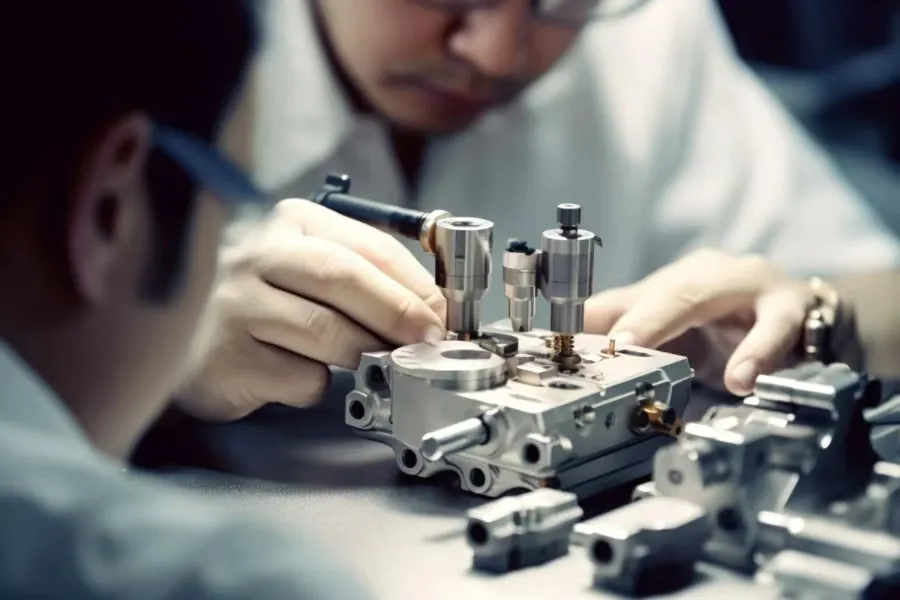
Practical Application Ability: There’s always a gap between theory and reality. You should be familiar with the processing methods of common metals and plastics (such as turning, milling, grinding, and injection molding) and understand the practical difficulties that assemblers may face with your designs. Engaging with workshop teams and suppliers directly is more valuable than reading numerous books.
Basic Cost-Consciousness: It’s not about financial accounting, but about having sensitivity to costs and processes. When designing a part, you should immediately consider questions like “How much will it cost to mill this from iron?” “Is it cost-effective to open a mold?” and “Can standard parts be used?” to avoid creating overly expensive designs.
Research and Reference Skills: No one can remember all knowledge. However, you must proficiently know how to check manuals (mechanical design handbooks are essential), find standards (national, European, American), and use relevant data. Knowing where to find answers when encountering problems is far more important than rote memorization.
Mindset: A Reliable Apprentice
Patience and Attention to Detail: In mechanical engineering, a tiny mistake can lead to huge losses. You need to repeatedly check drawings, verify parameters, and test prototypes. Avoid being impulsive—your “close enough” could be the root cause of a series of subsequent issues.
Proactivity: Don’t wait for your supervisor to assign tasks. Take the initiative to disassemble broken prototypes, analyze test data, and assist colleagues when they face difficulties. The more you engage, the faster you’ll grow.
Willingness to Ask Questions: If you don’t understand something, ask—don’t pretend to know. Seek advice from colleagues, mentors, and even supplier technical support. In the early stages, learning is more valuable than saving face.
Management: Managing Yourself
Task Management: Be able to manage your own tasks effectively, completing them on time and with high quality without constant reminders from your supervisor. Learn to use tools like checklists and schedules.
Closed-Loop Communication: Confirm receipt of instructions, report on completed work, and voice difficulties early. Keep all relevant parties informed of your progress to become a reliable link in the workflow.
Key Mechanical Engineer Skills for Senior Stages (5+ Years, Toward Expert or Manager)
At the senior stage, you become a “definer” and “decision-maker,” focusing on addressing issues like “is it correct” and “is it valuable.” The following skills are crucial for advancing to higher levels.
Technical Skills: A Holistic System Perspective
System Thinking and Architecture Capabilities: Move beyond focusing on individual parts to considering the entire system. For example, when designing a robot, you need to coordinate the interrelationships between structural strength, transmission efficiency, vibration and noise, thermal management, and control logic. You should be able to define product technical solutions and architectures, identifying key technical challenges and risk points.
Depth and Breadth of Knowledge: Develop expertise in 1-2 specialized areas, such as vibration analysis, heat transfer simulation, or precision structural design. At the same time, expand your knowledge to include basic understanding of electrical engineering, software, and hardware, enabling effective communication with experts from different fields.
Risk Prediction Ability: Drawing on extensive experience, anticipate most potential issues in production, testing, and usage during the design phase. Like a seasoned professional, you can quickly identify possible problems, helping the company save significant trial-and-error costs.
Mindset: A Responsible Leader
Decision-Making and Accountability: When faced with multiple technical solutions, make the “optimal” choice even with incomplete information and take responsibility for it. Be bold in making decisions and willing to accept accountability.
The Art of Balance and Compromise: Perfectionism can hinder senior engineers. You need to find the best balance between conflicting demands (performance, cost, schedule, reliability). Master the “wisdom of compromise”—achieve 95% of the desired effect with 80% of the cost instead of pursuing absolute perfection.
Curiosity and Continuous Learning: Technology evolves rapidly (e.g., additive manufacturing, new materials). To avoid obsolescence and lead your team forward, you must maintain a passion for learning and stay updated with industry advancements.
Management: Leading Teams to Achieve Goals
Project Management and Coordination: Be able to develop plans, assign tasks, control budgets, and manage risks to ensure smooth project progression. Coordinate internal teams (hardware, software) and external resources (suppliers, clients).
Translation and Communication Skills: Translate vague market needs from management into clear technical indicators for the team, and explain complex technical issues to sales teams and clients in simple terms. Act as a “connector” between internal and external stakeholders.
Mentoring New Talent: Be willing to share knowledge and train new employees. Passing on your expertise allows you to focus on more high-value work. The ability to identify potential in others and the patience to nurture them become increasingly important.
Conclusion
Mechanical engineer skills evolve with career progression—from mastering foundational technical crafts and self-management as an entry-level professional to developing system thinking, leadership, and strategic decision-making as a senior expert or manager. By continuously refining these core skills and embracing lifelong learning, mechanical engineers can not only drive innovation and solve complex engineering challenges but also build a successful and fulfilling career in this dynamic field.
Long-Tail Keywords
mechanical engineer technical skills, entry-level mechanical engineer competencies, senior mechanical engineer system thinking, mechanical engineer project management skills, mechanical engineer cost control abilities, mechanical engineer risk prediction expertise, mechanical engineer communication skills for cross-team collaboration
-300x153.webp "Ball Screw Precision Grades Explained: A Complete Guide for Selection")